


CEP活動紹介
2020/07/02 21:20:00 バーチャル・フィールドワーク Virtual Fieldwork in Wakayama
 CEP活動紹介
 Student Reporter
皆さんこんにちは。グローバル観光学科2年次生の石橋尚子です。今回は6月24日にWeb会議ツールzoomで行われた和歌山アメリカ村のバーチャルフィールドワークについてです。
私は来春、和歌山県で行われるCEP(Community Engagement Program)に参加します。プログラムの事前学習も兼ねて、zoom会議にお邪魔させてもらいました。会議には学科の河上先生やゼミ生の先輩方、和歌山大学や同志社大学の先生や学生さんが参加されていました。
第一部はカナダミュージアム館長の三尾たかえさんと東大を休学して昨年からアメリカ村に滞在している岩永淳志さんの司会進行で進みました。CEPで訪れる美浜町の説明、カナダミュージアムのバーチャルツアー(内観や展示資料の紹介)、そしてカナダへの移民の歴史で知られるアメリカ村に関する3択クイズをしました。
第二部は京都外大4年次生による卒業プロジェクトの発表があり、カナダミュージアムとの連携で地域の歴史を聞きとって動画保存を計画するアーカイブ班の企画や、ルーツ探しに訪れるカナダ人旅行客へのサポート活動、カナダ移民に関する映画の日本語字幕作成企画など、活動内容や今後の活動についてのプレゼンテーションを聞きました。
約1時間半の交流でしたが、あっという間に時間が過ぎてしまいました。現地のバーチャルツアーも、先輩方のプレゼンテーションも、とても興味深かったです。コロナウイルスの影響で私たちが和歌山県を訪れるのは来春となってしまいましたが、今からCEPの実施が待ち遠しいです!
日高新報に掲載の記事へのリンクはこちら。
Hello everyone! My name is ISHIBASHI Naoko. I belong to the Department of Global Tourism Studies as a Sophomore. This time, I am going to talk about my virtual fieldwork in Mio (America-mura), Wakayama which was held on zoom on June 24th.
I will join CEP(Community Engagement Program)in Wakayama next spring. I attended this zoom conference as part of the program's pre-study. Professor Kawakami of our department and her seminar students as well as the professors and students of Wakayama University and Doshisha University attended this virtual fieldwork opportunity.
The first part of the online conference was led by Ms. MIO Takae, the head of Canada Museum and Mr. IWANAGA Atsushi , an undergraduate student from Tokyo University. They gave us an explanation of Mihama-Cho where our CEP will be based and a virtual tour of the Canada Museum (introduction of the inside view and exhibition materials). We also enjoyed three-choice quizzes about America-mura known through its history of sending villagers to Canada.
The second part of the conference consisted of presentations made by 4th year KUFS students working on their graduation projects related to America-mura such as oral history archival projects and an interview research on Japanese Canadian roots tourism.
It was about one and a half hours of interaction, but the time passed quickly. The local virtual tour and the presentations by seniors were very interesting. We will be postponing our visit to Wakayama prefecture to next spring due to the corona-virus, but we can't wait to participate in the program!
-
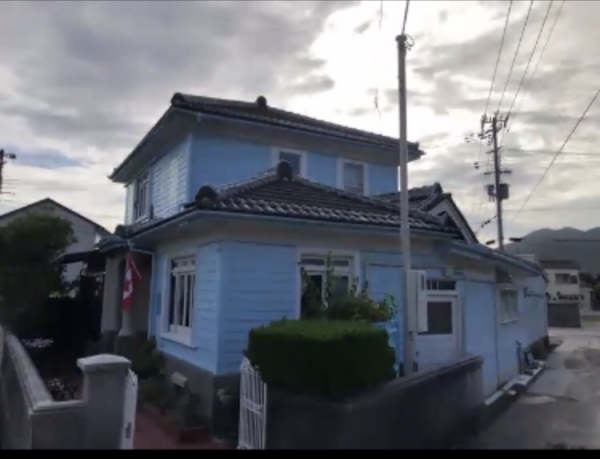 カナダミュージアム
-
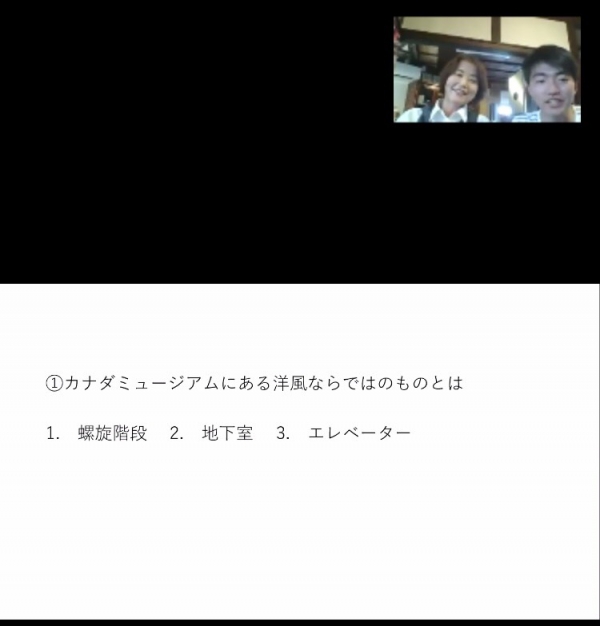 会議中の様子
2020/06/09 18:30:00 Community Engagement Program Guamを振り返って
- CEP活動紹介
- Student Reporter
こんにちは!グローバル観光学科3年次生の宮本千晴です。新型コロナウイルスの影響で今年度の海外での活動は、難しくなってしまいましたが、きっとまた再開できると信じながら、今日は昨年11月16日〜12月13日(4週間)にグアムで行われたCommunity Engagement Program(CEP)について紹介したいと思います。
CEPグアムでは、最初の2週間はグアム大学に通い、次の1週間はホテルでインターンシップ、最終週の3日間は旅行会社でのインターンシップ、最終日にはプレゼンテーションを行いました。また、土日には有志でBGツアーズのインターンシップにも参加しました。
グアムは、日本からグアムまでのフライト時間は約3時間半で、時差は1時間という日本から一番近いアメリカです。また、年間を通じて温度変化が少なく、年平均気温は約26℃の常夏の島です。島の大きさは淡路島とほぼ同じ大きさです。
最初の2週間に通ったグアム大学では、CEPグアムのメンバーで英語の授業を受けました。食べ物の食感を表す形容詞を学んだり、英語でストーリーを作成したりしました。グアム大学の学生とも交流があり、一緒にゲームをしたりランチを一緒に食べたりできたので、すぐに仲良くなることが出来ました。
3週目には、パシフィックスターホテルでインターンシップを行いました。3グループ6人ずつに分かれて、グループごとに交代でフロント、ハウスキーピング、F&Bを経験しました。インターンシップ最終日には、800人規模の大きなパーティーが開催されたので、全員でパーティーの手伝いをしました。
3週目の土日では有志(5名)でBGツアーズのインターンシップへ参加しました。土曜日は、ライドザダックスとサンドキャッスルのインターンシップ、日曜日は、タオタオタシのインターンシップでした。ショーの食事補助のインターンシップだったので、インターンシップ終了後には実際にショーを鑑賞させていただきました。
最終週は、3日間旅行会社で就業体験をしました。カヤックに乗って川下りをする体験のほか、実際に旅行会社のカウンターに座らせてもらったり、電話を取ったりもしました。
最終日には、「グアムでの日本人旅行者の滞在日数をいかにすれば3泊4日から5泊6日に延ばせるか」というテーマのもと3人グループでプレゼンテーションを行いました。
グアムで過ごした4週間はとても内容の濃い体験ができ本当に楽しかったです。グアム大学の学生とも仲良くなることができ、毎週末一緒に出かけていました。私はグアムCEPに参加して充実した時間を過ごせてよかったと思います。このブログを読んでCEPグアムに興味をもつ人が少しでも増えたら嬉しいです。グアム滞在中に学生広報隊のインスタも更新したので、ぜひご覧になってください(#ce_Guam)。そしてこちらは、一緒にグアムでのCEPを経験した佐野香織さんが、作ってくれたyoutube動画のリンクです。ぜひ見てください。
Hello. My name is Chiharu Miyamoto. I’m a sophomore student of Global Tourism Studies Department. Today, I would like to write about my experiences of the Community Engagement Program in Guam. We went there from 16th Nov to 13th Dec, last year.
On CEP Guam, we went to the University of Guam for 2 weeks, then we did an internship for 2 weeks at a hotel we stayed and also at a travel agency. On the last day, we gave a presentation about our experiences and research. Also, those who were interested in working as an intern at a travel agency called BG tours had internship on a weekend.
I will introduce about Guam a little. It takes about 3 hour and a half hours from Japan to Guam. Guam is the nearest America to Japan because there is only an hour time difference. Also it is always warm in Guam. The average temperature is about 26 ℃. Guam is almost as large as Awaji-Shima island.
We took classes at the University of Guam (UOG) for the first 2 weeks. We learned many kinds of adjectives that describe food textures and also made original stories in English. UOG students helped us, and we spent a lot of time with them.
On the 3rd week, we had internship experiences at Pacific Star Resport & Spa. The CEP Guam members were divided into three groups of six and experienced work at front desk, housekeeping and F&B sections. As there were big parties on the last day of our internship, we engaged in such tasks as taking away plates and poaring water.
On the 3rd weekends, some of us volunteered to take part in the BG tours’internship. We participated in the internships of Ride the ducks (riding an amphibious vehicle) and Sand Castle (a magic show) on Saturday and TAOTAO TASI (a local dance show) on Sunday. Since both of the shows were dinner shows, we were given the opportunity to enjoy the shows after the internships.
We had internship experiences at a travel agency for 3 days on the 4th week. We could experience kayak river cruise, worked at the counter and got the phone.
On the last day, we were in six groups of 3 persons to make presentations about the question“How we can change the length of stay of Japanese tourists from 4 days 3 nights to 5 days 4 nights in Guam.”
I had a very good time in Guam. We were able to make friends with UOG students and hung out with them every weekend. The CEP Guam felt the best program for me. I would be glad if you became interested in the CEP Guam after reading this blog. I believe that you will really have a good time in Guam. We posted pictures through our official and personal Instagrams. Please visit there (#ce_Guam). Lastly, here is a youtube video that my classmate Kaori Sano created. Please enjoy!
-
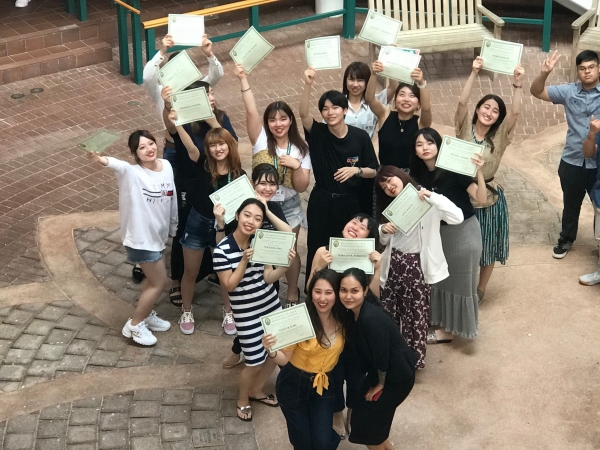 グアム大学での修了式
-
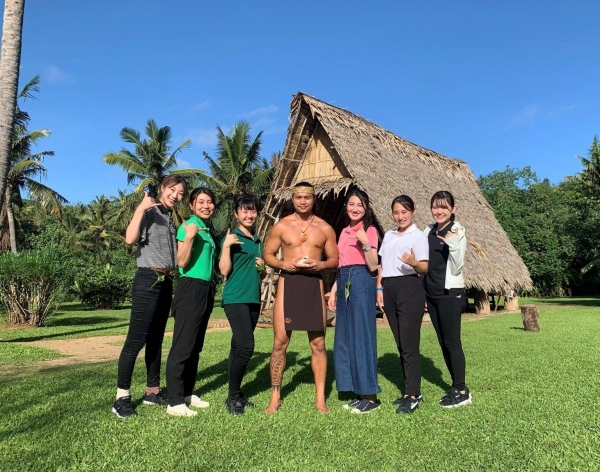 旅行会社でのインターンシップ
2019/12/19 17:20:00 Community Engagement Presentations コミュニティ・エンゲージメント・プログラム活動報告会
- CEP活動紹介
- KUFS Global Tourism
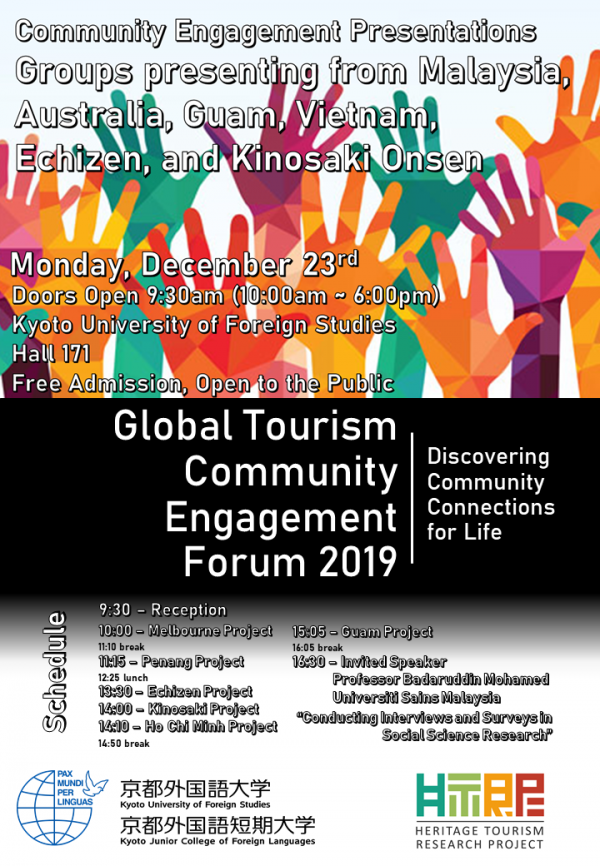
来たる12月23日(月)、10時から18時(予定)まで、171教室にて、グローバル観光学科主催で今年度第2回目のコミュニティ・エンゲージメント・プログラム活動報告会をおこないます。
今回は秋学期にオーストラリア、グアム、マレーシア、ベトナム、越前、城崎温泉に赴いたグローバル観光学科2年次生の27チームがそれぞれの学びを発表します。
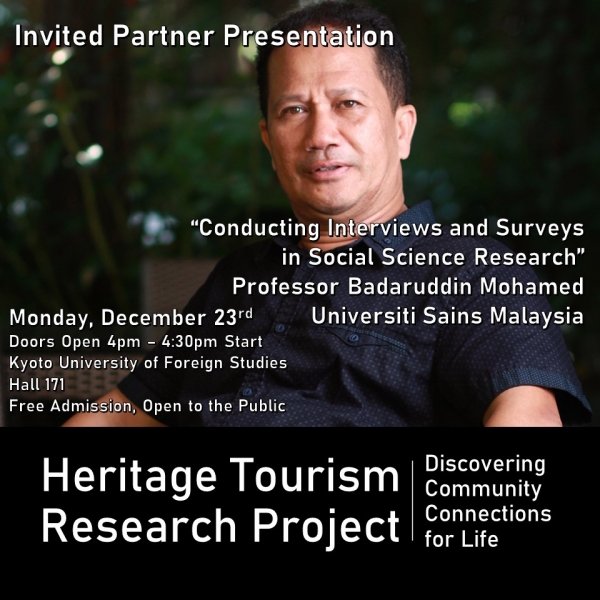
また16時半からは、マレーシアのCEプログラムのホスト機関でもあるマレーシア科学大学のバダルディン・モハメッド教授の講評を兼ねたスペシャル・レクチャーが予定されています!
ぜひよろしければ、皆さん学生たちの成果を聞きにいらしてください!
12月23日(月) 171教室
9:30~ 開場(R171)
10:00~11:10 オーストラリア・メルボルンCEP報告(7チーム)
11:10~11:25 休憩
11:25~12:25 マレーシア・ペナンCEP報告(6チーム)
12:25~13:30 昼休み
13:30~14:00 越前CEP報告(3チーム)
14:00~14:10 城崎CEP報告(1チーム)
14:10~14:50 ベトナム・ホーチミンCEP報告(4チーム)
14:50~15:05 休憩
15:05~16:05 グアムCEP報告(6チーム)
16:30~17:45 バダルディン・モハメッド先生の特別講義(報告への講評含む)
The Department of Global Tourism Studies proudly invites you to a whole day of sharing stories about experiences during community engagement programs in Fall 2019. There will be reports and discussions from teams that did programs in Australia, Guam, Malaysia, Vietnam, Echizen, and Kinosaki Onsen.
In the afternoon we will have a special invited speaker from Universiti Sains Malaysia, Professor Badaruddin Mohamed. Please join us!
Doors open at 9:30 am and profeedings begin at 10am.
2019/11/18 18:10:00 Community Engagement Program: Kinosaki Report
- CEP活動紹介
- Student Reporter
Hello, my name is Nanami Shimaoka, a second-year student in the Department of Global Tourism Studies. During the summer vacation, I participated in the Community Engagement Program. I went to Kinosaki Onsen (hot spring town) in Hyogo, Japan, and I worked there and researched tourism from the perspective of SDGs(Sustainable Development Goals). Now I will report on the CEP in Kinosaki.
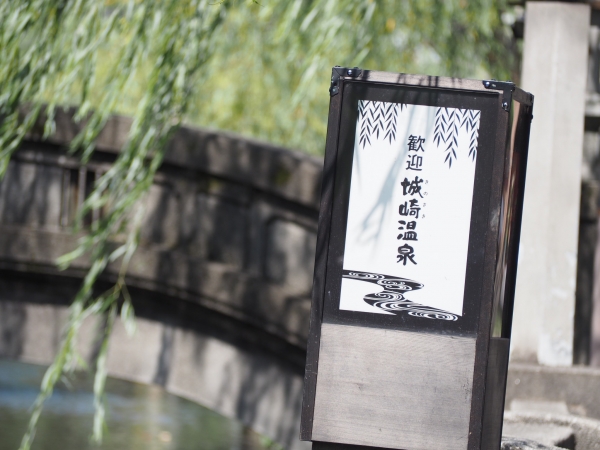
Kinosaki Onsen is a hot spring town located in Toyooka, Hyogo. The town is famous for seven public hotsprings, or “onsens” where you can visit wearing Yukata and Geta. (Japanese style clothes and shoes). Kinosaki Onsen has cherished the concept of coexistence and coprosperity, and it is seen that the whole town symbolizes a “ryokan” (Japanese-style hotel). For example, the station is considered as the entrance of the ryokan, and the ryokan represents a guest room while the road is a passage way. The public hot spring bathhouse is seen as a bathroom. This idea gives Kinosaki full energy.
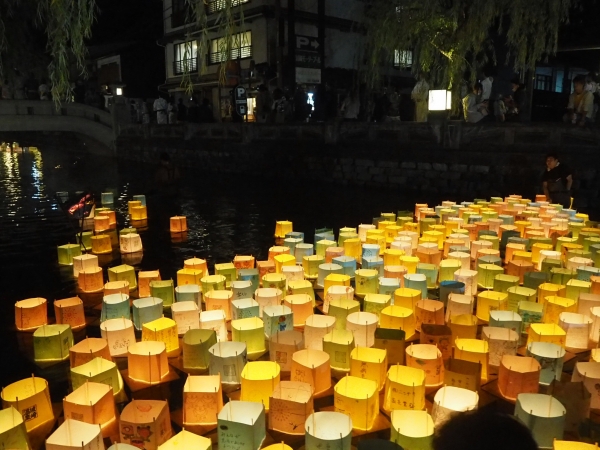
I stayed at a Japanese-style inn called Nishimuraya. Nishimuraya had two accommodations. One is a a Japanese traditional “ryokan” named “honkan,”which means a main building in Japanese, the other is a hotel named “Shogetsutei.” I worked at both places. The main activity of CEP in Kinosaki is mainly experiencing hotel customer service, and I work as a room clerk and a front desk receptionist in Nishimuraya. We usually worked for eight hours a day, from two to four days a week. On our days off, we strolled around in Kinosaki or prepared the final report. As A summer festival was held, and the fireworks were seen almost every day. There were street stalls, and on the last day of the summer festival, we were excited about floating lanterns on the water. Moreover, I enjoyed nice cafés and shops in Kinosaki. For a month, I stayed in a single guest room in Shogetutei, Nishimuraya. There were a TV and a refrigerator in the room, and the washing machine was also available for use. I was satisfied with the life in Kinosaki.
I was able to experience two types of work. One is a room clerk. The room clerk had two sub-categories: the room clerk staff and the staff who helps the room clerk. The room clerk staff takes charge of one or two guest rooms. The morning jobs include putting away futon mattresses, serving the breakfast, and sending the guests off. After the guests left, the room clerk staff cleans the room and sets up amenities for the next guests. After all that, they can take a rest. In the evening, the room clerk serves dinner and lays out futon, or Japanese-style bedding. The staff who helps the room clerk cleans rooms and prepares tea and snacks in the morning. Unlike the room clerk, there are no rooms that they take charge of, and they move around rooms to provide assistance. In the evening, they escort guests to their rooms, serve tea and snacks, and explain about the hotel. They also have some other responsibilities.
The other position I experienced was a front desk receptionist. A receptionist is an important job which mainly deals with check-in and check-out procedures as well as taking care of guests’ shoes and room keys. In the morning, the receptionist takes care of the check-outs of guests, helps guests to carry their luggage, and seeing them off. After the lunch break, we assisted new guestswith their checking-in, showed them their rooms, served tea, snacks, and so on. When it was not busy, we cleaned around the reception desk or dealt with guests who needed assistance. How the front desk is perceived by guests is important because it is the first and last place where guests come to during their hotel stay. It was hard until I got used to dealing with a lot of customers toward the end of the check-out time. It was also challenging to know when guests would show up for checking-in. We needed to be prepared at any time because of that. It was difficult to have a wide field of vision, but I was satisfied with meeting various kinds of people.
What I experienced as a room clerk and receptionist were both rewarding and challenging. However, I think that both positions enabled me to become a part of “customer’s memory,” and this is an appealing point of working for ryokans and hotels. In addition to working at the ryokan, we conducted a survey on the working environment of employees working for Nishimuraya in relation to the No.8 of SDGs. Before we went to Kinosaki, we learned in class that the hotel and service industries had a high rate of turnover. So we researched the current situation in Kinosaki, and based on the research, we proposed a few things to make better working environments.
I was able to experience a variety of things for a month I stayed in Kinosaki. There were hard times, but also there were many things that I could learn, so I thought I had a good time in Kinosaki. I highly recommend the CEP in Kinosaki!!
-
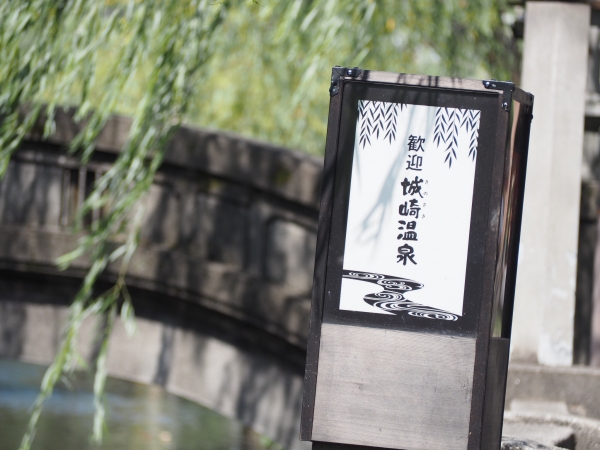 Welcome to Kinosaki Onsen
-
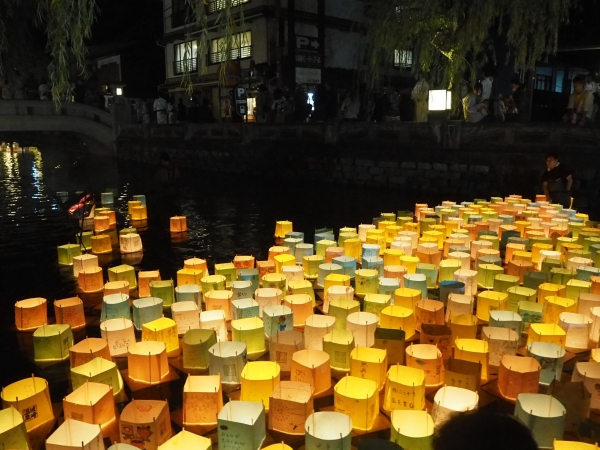 Floating lanterns on the water
-
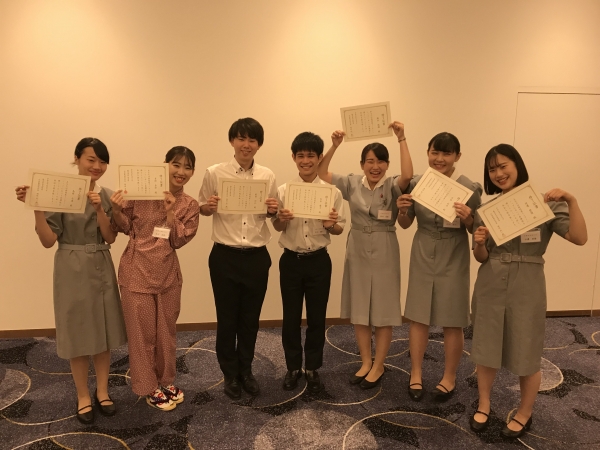 We received a certificate of program completion!
2019/11/09 09:00:00 コミュニティ・エンゲージメント・プログラム城崎レポート
- CEP活動紹介
- Student Reporter
こんにちは。グローバル観光学科2年次生の島岡七海です。
私は夏休み期間、コミュニティエンゲージメントプログラムに参加してきました。
8月5日から9月6日までの約1か月間、城崎温泉での実習、観光調査を行いました。
ということで、今回はCE城崎(夏)についてレポートしたいと思います!
まず、城崎温泉について紹介します。城崎温泉は兵庫県豊岡市にある温泉街。7つの温泉が街にあり、浴衣を着て下駄を履いて外湯巡りをすることで有名です。城崎温泉では「共存共栄」という精神から、“街を一つの旅館”とし、駅は玄関・旅館は客室・道は廊下・外湯はお風呂・・・という風に考えられています。そのため、地域全体で盛り上げていこうという活気を感じることが出来ます。
次に、1か月間の過ごし方についての紹介です。私は城崎温泉で有名である西村屋でお世話になりました。西村屋には旅館である“本館”とホテルの“招月庭”があり、どちらでもお仕事をさせて頂きました。基本的には接客する業務を体験するプログラムで、私は西村屋 本館で客室・フロント業務、西村屋 招月庭で客室業務をしました。1日8時間勤務、2~4連勤のシフトで働き、休日は城崎散策や最終発表に向けた準備を進めていました。私が行った時期にはちょうど夏祭りが行われ、ほぼ毎日花火が上がり、屋台が出る日や最終日は灯篭流しで盛り上がっていました。美味しいレストランやおしゃれなお店などがあり、城崎散策ではたくさんの思い出が出来ました。お部屋は、1人に一室を用意して下さり、昼食・夕食も頂きました。テレビ・冷蔵庫が部屋にあり、洗濯機も近くで使わせて頂き、充分に快適でした。
続いてはお仕事についての紹介です。まずは客室業務について。客室係には「客室」と「客室ヘルプ」という役割に分かれています。客室係とは1人1~2室を担当し、そのお部屋のお客様の接客をします。午前中は担当のお部屋のお布団上げ・朝食配膳・お見送りです。お客様がお帰りになると、担当部屋のお掃除・アメニティ類の準備をし、中抜けに入ります。そして、夕方からお仕事に戻り、新たに担当になったお部屋のお客様の夕食配膳・お布団敷きをします。
客室ヘルプとは名前の通り、客室係のお手伝いです。午前中はお帰りになったお客様のお部屋や廊下のお掃除・お茶菓子の準備などです。客室係とは違い、担当のお部屋というものがないので全体的に動くというイメージです。午後はチェックインされたお客様をお部屋で案内・お茶出し・館内の説明等です。この業務の流れはおおまかであり、その他たくさんのお仕事があります。
客室係・ヘルプはお客様との距離が近いため、濃い接客をすることが出来ます。色々なお話をすることでお客様と親しくなり、お別れが寂しいですが、そのお客様に「ありがとう」と言われることが嬉しいです。仕事は体力的・精神的にも大変ですが、直接感謝されることがお仕事のやりがいであると感じました。
フロントは主にチェックイン・チェックアウトなど宿泊手続き、またお履き物やカギなど宿泊客の管理をする大切なお仕事です。午前中はチェックアウト業務・お荷物を運ぶお手伝い・お見送り・連泊のお客様対応などです。午後はお出迎え・チェックイン業務・客室までのご案内・お茶出し等です。時間があるときにはフロント周りのお掃除や迷われているお客様のご案内など、たくさんのお客様に接客できます。
フロントはお客様が来られる時、またお帰りの時に必ず立ち寄る場所です。つまり、最初と最後に関わるため、フロントでの印象がとても重要になってきます。また、チェックアウトの終了時間が迫ると一気にお客様が来られるので慣れるまでが大変でした。反対に、チェックインではいつご到着されるのか分からないことが多いので、常に準備しておく必要があります。視野を広げてお仕事しなければいけませんが、様々な年代や国の方とお話しできることがフロントのやりがいかなと思いました。
客室係とフロントではそれぞれにやりがいがあり、またそれぞれに難しさ・大変さがあります。しかし、どちらでもいえることは「お客様の思い出の一部」になれる旅館・ホテル業は他の仕事では出来ないこと、感じられないことなのかなと思いました。
また、城崎での観光調査は労働環境に関して発表しました。SDGs番号8番にも関係してきます。事前学習で宿泊業・サービス業の離職率が低いということを知りました。そこで、城崎では実際どうなのかというや、働いて感じたことから私たちなりの提案をさせて頂きました。1か月間、色々な経験をさせて頂きました。大変なこともありましたが、勉強になることがたくさんあり、行って良かったです。必ず成長して帰って来れるプログラムだと思うので、ぜひ1年次生には行ってほしいです。
-
 城崎の街並み
-
 灯籠流しの様子
-
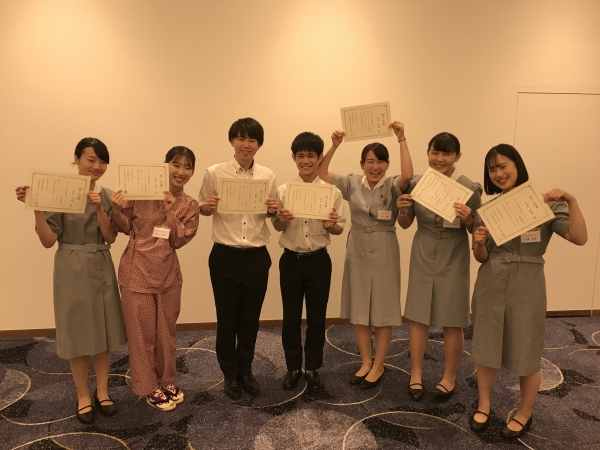 最後に賞状を頂きました!


