


2026/04/09 17:40:00 Learning About Tourism and Community Connections in Thailand
 学外活動
 3年次 北村桃子、宮澤寿音、樋口育帆
Participating in community engagement activities in Thailand
Hello everyone. This report is compiled by Momoko Kitamura, Kotone Miyazawa, and Ikuno Higuchi. We are third-year students in the Department of Global Tourism. From February 4 to 19, 2026, we participated in the Community Engagement activities in Thailand. This program is designed to deepen students’ understanding of tourism and local communities through hands-on learning during approximately two weeks of spring break. The university provided strong support throughout, from pre-departure guidance to on-site assistance, which allowed us to participate with confidence. During the program, we explored tourism-related and regional challenges in Thailand, considered possible solutions, and developed promotional ideas to encourage young people in Japan to visit the country.
What We Learned from On-Site Experiences
Throughout the program, we engaged in a variety of experiences that could only be gained by being in Thailand. These included traditional Thai dyeing, a food bus tour, and lessons in Muay Thai and Thai dance. Among these, the most memorable experience for me was kayaking and Thai dyeing in Bankorbua.
Bankorbua is part of Bang Kachao, an area often referred to as the “lung of Bangkok.” Despite being located within the city, it is rich in greenery. There, we learned how local residents attract tourists and how they address challenges associated with tourism. We also participated firsthand in activities such as kayaking tours and Thai dyeing. By hearing directly from local people about their perspectives on tourism, I came to feel that Thailand should move away from mass tourism focused on quantity and instead promote tourism that values the unique characteristics of each region and the experiences of local communities.
What We Learned from Visiting the Tourism Authority of Thailand (TAT)
During a lecture by Mr. Kentaro Shikano from the Tourism Authority of Thailand (TAT), we learned about the current state and strategies of Thai tourism based on the latest data. One particularly striking point was that Japan’s passport ownership rate remains below 20%, highlighting the current limitations of the outbound travel market. We also learned that consumer trends are shifting from the consumption of goods to the consumption of experiences.
Based on these insights, we were divided into four groups to develop tour plans and promotional strategies aimed at encouraging young Japanese travelers to visit Thailand. My group focused on the issue of excessive concentration in Bangkok and explored ways to highlight the appeal of lesser-known regional areas. In designing our tour plan, we emphasized “human interaction,” which we personally experienced and found especially meaningful during the program. Through this experience, I realized that tourism studies involve more than simply creating travel plans. They require the use of objective data and the concept of “co-creation,” in which local communities and tourists work together to generate new value. I hope to apply the diverse perspectives I gained through this program to my future studies.
Reflections on the Program
By participating in the Thailand Community Engagement activities, we were able to engage directly with local communities in ways that are not possible through conventional tourism. These interactions allowed us to experience the warmth of the Thai people and to better understand differences between Thailand and Japan in both tourism and everyday life. It was a valuable opportunity to go beyond the role of a typical visitor.
Through this program, I personally gained many insights and also identified areas for my own personal growth. Moving forward, I intend to build on what I learned in Thailand and continue striving for further development.
-
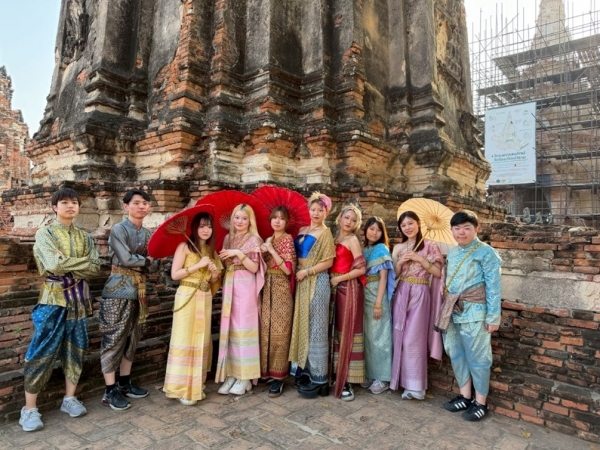 ①Experiencing ethnic costumes at the Ayutthaya World Heritage Site 世界遺産アユタヤでタイの民族衣装を体験
-
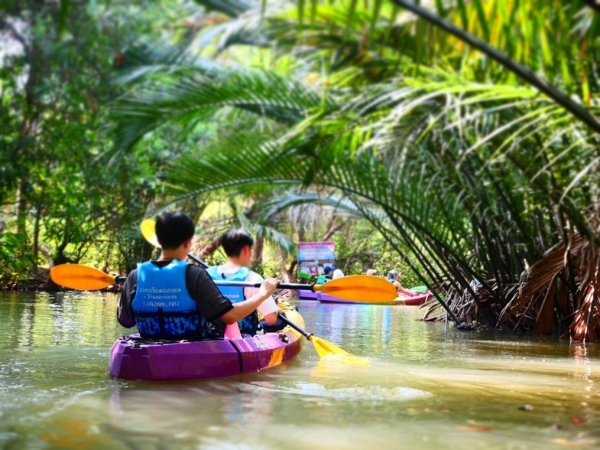 ②Experiencing Kayak in Bankorbua “バンコクの肺”Bankorbuaでのカヤック体験


