


2024/06/22 20:30:00 My Hometown Yangzhou
 地元紹介
 広報隊オウ
Hello everyone, I'm Wang Zhongxu, a freshman in the Department of Global Tourism. I'm from Yangzhou City, Jiangsu Province, China. I have a personal belief that "people who like Crayon Shin-chan are definitely not bad people." Certainly, Shin-chan is ridiculous and vulgar, but he is always bright and positive, giving warmth and joy to the people around him like a small sun. So, I love Crayon Shin-chan.
Today I'd like to introduce my hometown, Yangzhou. First of all, Yangzhou is a city located in the middle of Jiangsu Province, China. Situated at the intersection of the Yangtze River and the Grand Canal, it has flourished as an important city since the Spring and Autumn Period. During the Qin Dynasty, it became the county seat of Guangling County, and in the Han Dynasty, it became the county seat of Guangling Commandery. During the Wei, Jin, and Northern and Southern Dynasties, it became the capital of the Southern Dynasties: Song, Qi, and Liang, flourishing as a cultural center. In the Sui and Tang Dynasties, with the opening of the Grand Canal, it became even more prosperous and became one of the leading commercial cities in China. Yangzhou City is a treasure trove of cultural heritage with a history of more than 2,500 years. There are many tourist attractions such as Slender West Lake and Daming Temple, both of which are registered as World Heritage Sites.
Slender West Lake is a landmark tourist attraction in Yangzhou. It is also registered as a World Heritage Site and is counted among the four famous gardens in China. The West Lake is famous for its winding lakesides, beautiful bridges, and many pavilions and temples. Daming Temple is one of the oldest Buddhist temples in China. It was built in 602 and is also famous as the temple where the monk Jianzhen stayed before he traveled to Japan to spread Buddhism. Daming Temple houses many valuable Buddha statues and sutras. Due to this historical connection, Nara City in Japan and Yangzhou City have been promoting friendly exchanges since 2002. In February 2010, to mark the 1300th anniversary of Nara's establishment as Japan's capital, a delegation led by Nara's Mayor Gen Nakagawa visited Yangzhou City and exchanged a Memorandum for the Conclusion of a Friendship City Relationship. On May 23 of the same year, at the Nara Centennial Hall, the two cities officially held a signing ceremony for a friendly city alliance, agreeing to cooperate in fields such as economy, culture, tourism, human resources, and sports. Additionally, on April 21, 2014, former Japanese Prime Minister Yasuo Fukuda visited the Jianzhen Memorial Hall at Daming Temple in Yangzhou City, Jiangsu Province, wrote 心連心 (Heart to Heart), and presented it to the temple.
Next, Yangzhou City boasts many intangible cultural heritages, such as Yang Opera, paper cutting, and the Yangzhou Three Knives. The old cityscape remains preserved in an area called Dongguan Street, where traditional shops and restaurants line the streets. In Dongguan Street, you can buy Yangzhou's famous pickles, the Yangzhou Three Knives, and other traditional products. Finally, Yangzhou is the birthplace of Huaiyang cuisine, a major style within Jiangsu cuisine, one of the four great cuisines of China, with a long history of food and beverage culture. Huaiyang cuisine is characterized by its delicate taste and beautiful presentation. For example, there are many restaurants in Yangzhou where you can savor Huaiyang dishes such as Yangzhou fried rice, crab meat lion's head (large meatballs), and dried bean curd strips. The roots of Yangzhou fried rice can be traced back to a dish called Yueguo crushed gold rice in the Sui Dynasty menu book 谢讽食经. This dish, described as crushed gold rice (rice like pieces of gold) from the Yue State (present-day Zhejiang), is said to be the predecessor of Yangzhou's egg fried rice. It is unclear whether fried rice existed in its current form during the Sui Dynasty, but over time, crushed gold rice was brought to Yangzhou, improved upon, and enhanced with additional ingredients, evolving into today's Yangzhou fried rice. Each grain of rice is wrapped in egg, and when stir-fried, it shines like gold.
-
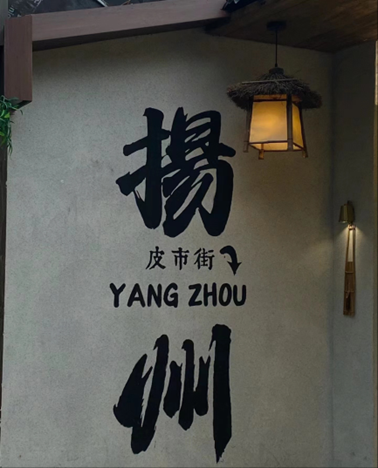 The sign of Yangzhou (Photo by sunflower)
-
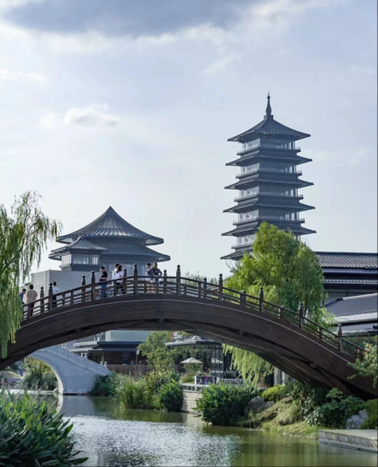 Slender West Lake during the day (Photo by sunflower)
-
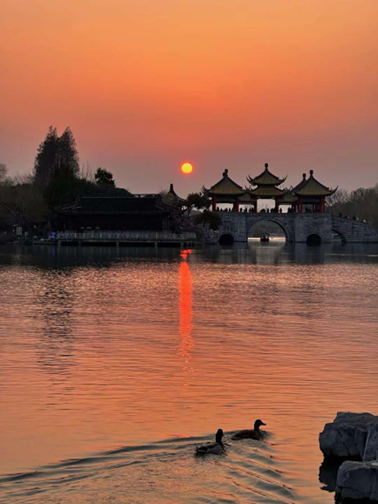 Slender West Lake in the evening (Photo by Tyrone)


