


2021/03/01 01:50:00 【CEP越前】3:越前焼に挑戦~作陶~
 CEP活動紹介
 Student Reporter
こんにちは。グローバル観光学科の2年次生の八島美奈です。私たちのCEP越前の活動をご紹介します。私たちは活動の一貫として陶芸作りを行います。活動の中で焼き物作りを行う理由として、伝統工芸である六古窯の1つである「越前焼」の再生復興が挙げられます。12月の現地での活動の前段階として越前陶土を使用し手捏ねで焼き物作りを行いました。そして今回、社会福祉法人なづな学園の渡邉さんと中村さんにご協力していただきました。
実際行った焼き物作りの工程を紹介します。まず、陶土を柔らかくなるまで手でならします。次に、ろくろに陶器の底の部分になる陶土をドーナツ状に置きます。そのあと、ドーナツ状の陶土をその上に次々とのせていき内側と外側の繋ぎ目を手で丁寧に慣らします。自分の作りたい陶器をイメージして形を決めて作ります。コップやお椀などみんな好きなものを作って陶芸を楽しみました。陶土と陶土をならす際に力加減などが難しく、薄すぎると割れてしまったりする可能性があるので、厚さを調節するのに苦労しました。
12月4日には、現地で私たちの作った焼き物を野焼きする予定でしたが、あいにく雨のためできませんでした。続く1月熊谷は雪に覆われ、またコロナもあって野焼きはできないままです。野焼きはとても珍しいことなのですごく楽しみでしたが、暖かくなってから再挑戦できればと思います。
Hello everyone! My name is Mina Yashima, and I am a sophomore in the Department of Global Tourism Studies(DGT). Here I will introduce some of the activities we partake in as part of our Community Engagement Program (CEP) in the Echizen region.
One activity was pottery, and one of the reasons for this was to reconstruct and revitalize a traditional craft, Echizen-ware is known as one of the six ancient pottery traditions of Japan. As a preliminary step back in December, we were lucky enough to obtain some clay sourced from Echizen and practiced kneading it by hand. On this occasion, we learned how to make it from Mr. Watanabe and Mr. Nakamura, who work at Nazuna Gakuen, which is a social welfare corporation.
Let me introduce the actual process of making pottery. First, we work the clay by hand to make it smooth and soft. Next, put some clay on a potter's wheel – this will become the base of the vessel. After that, place a long coil of clay on the clay base and build up the walls of the vessel by wrapping the coil on top of the previously layer, smoothing out the seams both inside and outside by hand.
We were free to decide any shape we wanted to make. Everyone enjoyed making pottery such as cups and bowls. It was hard for me to adjust the thickness of the coil walls because it was difficult to adjust the force I applied when smoothing the clay. If I made the walls too thin, it might crack in the kiln.
On December 4th, we were planning to fire the pottery we made using the noyaki style of firing, which means we would fire our pieces uncovered in the ground, but unfortunately it was not possible due to rain. The following January, Kumadan was covered with snow and also due to COVID 19 we were again unable to fire the pieces in the noyaki tradition. I was really looking forward to it because it is very rare experience to create pottery this way, but I hope we can try again after it gets warm.
-
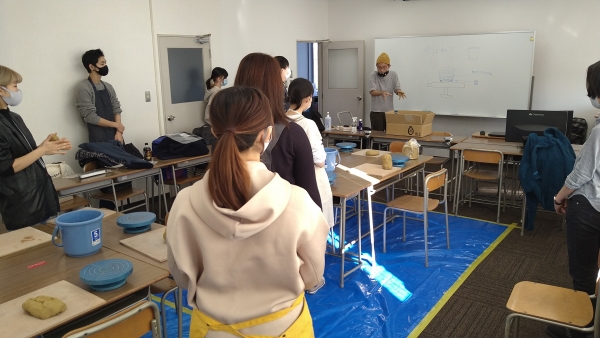 この3枚の写真は、南が撮影しました。まず、なづな学園の渡邉さんから作陶の基本を学びます。
-
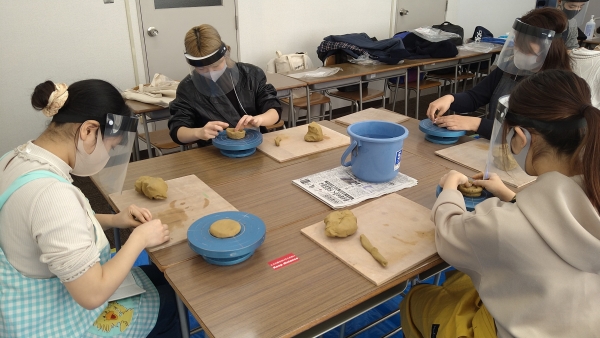 作り方はわかっても実際にやってみるとこれがなかなか難しい。悪戦苦闘・・・しかし、だんだん慣れてくると、それぞれの個性が出ます。中にはヘビとか鼻とか・・・ちょっと方向が違いますよね~。
-
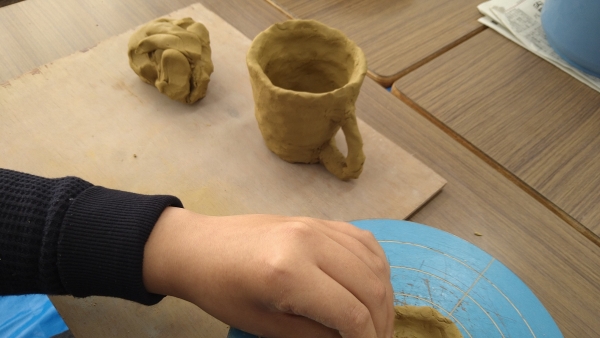 ブログを書いた八島さんの作品です。


