


2021/02/13 00:20:00 【CEP Echizen】1:Recording our presentation
 CEP活動紹介
 Student Reporter
Hello, I’m Momoha Fujimatsu and I’m a sophomore at the Department of Global Tourism Studies. I’d like to introduce the Community Engagement Program (CEP), one of our required subjects, as well as a CEP activity that I participated in.
As happened the previous year, CEP Echizen planned to hold a briefing session at the Sagichō event, which is held in January, at which we could relay a summary of our work to the residents of Kumadan, who have helped us a lot with our CEP activities. However, the event was cancelled due to COVID-19. So Prof. Minami and eight members of the CEP Echizen team recorded a video gathering on MS Teams, which featured PowerPoint slides made by each team member. We will send this video to the residents of Kumadan.
In addition to this blog post, and my team mate Shimokawa will write about plant-based dyes made using tall goldenrods - a troublesome weed in hilly and
mountainous areas, and after that my team mate Yashima will upload a story about outdoor baking as a way to revitalize Echizen ceramic ware. Shimokawa also will write a post summarizing our activities.
We covered six points in our presentation including what we had done, the results of our research into food culture, our experience making ceramics, proposals for how to use the site of the Kuemon Mizuno residence, plant-based dyes and how to eat wild grass, as well as introducing recipes which we thought up following on from our research into food culture. I introduced our research in the blog post of January 29th, so please be sure to give it a read. The blogs about making ceramics and plant-based dyes will also be uploaded in the near future. Mr. Mizuno is a researcher of old kilns in Echizen. The site of the Kuemon Mizuno residence is unoccupied ground now and we knew that residents of Kumadan were considering ideas for how best to use the site. We suggested glamping as a way of using the location.
We introduced 5 recipes including boiled food flavored with sugar and soy sauce using pandamame, literally “panda beans” with red kidney beans, shiitake mushrooms and ginger boiled in soy sauce, fried daikon, winter melon cream soup, and rice bran snowball cookies. These recipes are a modern take based on more traditional fare. Prior to recording the video, two team members cooked these dishes and delivered them to Mr. Minami. He packed them in his box lunch and ate it during the session. I was pleased with his reaction and it was a good opportunity for me to use new ingredients as well as to try out a new way of cooking.
It was my first time to listen to a presentation like this, and because some of the members did additional research, I was able to study. I think it we were able to summarize our activities whilst fulfilling our respective responsibilities.
It is unfortunate that the briefing session was cancelled and we couldn’t express our gratitude to the residents of Kumadan directly. However, as Mr. Minami says: fields don’t go anywhere. They endure, so be relaxed and happy. When this difficult situation gets better, I’d like to visit Kumadan. I’m looking forward to communicating with everyone there again.
-
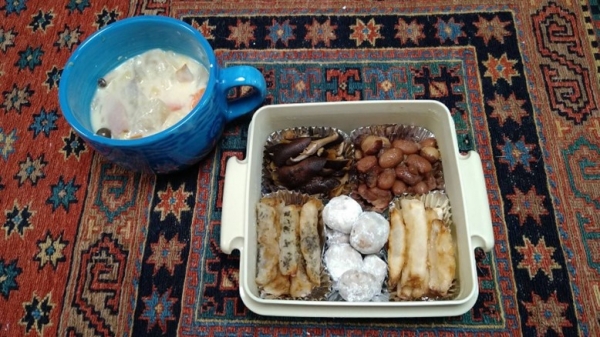 a lunchbox including 5 dishes


