


2026/5/26
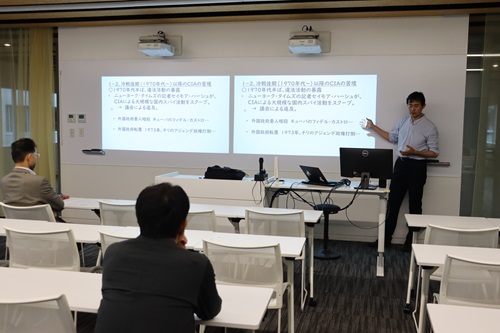
On Friday, May 22, the Research Office for International Studies hosted a special lecture titled "Understanding Twenty-first-century American Diplomacy through Changes in Intelligence Measures." The lecture was delivered by Associate Professor Naoki Ohno, Deputy Chair, Department of British and American Studies, Faculty of Foreign Studies. Students listened attentively throughout the session.
Mr. Ohno explained the importance to the United States of maintaining an appropriate degree of distance between policy decision-makers (such as the president) and intelligence agencies—not too close, yet not too distant. He also traced the history of the Central Intelligence Agency (CIA) and other American intelligence agencies, starting with the CIA's role as an independent and discrete intelligence analysis agency around the start of the Cold War, the agency's challenging position amid the politicization of intelligence in the 1970s, the agency's slow period in the 1990s after losing its primary adversary (the Soviet Union), and the pressure put upon intelligence agencies following their failure to issue early warnings prior to the September 11, 2001 terrorist attacks. Drawing on these developments, he outlined the characteristics of US intelligence agencies in the twenty-first century.
He also talked about the CIA's strengthened anti-terror and military roles, the pronounced politicization of intelligence as seen in the Iraq War, friction between the Trump administration and intelligence agencies, and other aspects of US intelligence as a means of understanding contemporary American diplomacy.
Page top


