


イベント
2026/07/07 14:20:00 Finding Belonging in the "Wiggly Space": A Guest Lecture on Bazaar Café
 イベント
 Junko Kondo
On July 3rd, Community Engagement Workshop A welcomed Professor Martha Mensendiek of Doshisha University's Department of Social Welfare, who is also the representative of Bazaar Café. Located near Doshisha University, Bazaar Café began as a project between the Kyoto district of the United Church of Christ in Japan and a group of artists, university faculty, missionaries, and pastors. Its founding aim was to create a space where people living very different realities — across sexuality, age, and nationality — could be accepted as they are, where each person's values are respected. Bazaar Café also provides employment to foreign residents of Japan and others who, for various reasons, find it difficult to access work.
The lecture began with her personal experience growing up in Japan with a US background, and her enthusiasm for supporting diverse people with various backgrounds in Japanese society. As she noted — and as we observe today — Japanese society sometimes insists on homogeneity and shows xenophobia, and Bazaar Café is one of the places providing a safe space within a society inclined toward homogeneity, welcoming people regardless of their “labels” in the society. Bazaar Café does not organize itself around fixed identities or social categories. Instead, it is built on three guiding principles: respecting anonymity, valuing relationships that are not fixed in advance, and creating a space where everyone simply belongs.
One idea that particularly captured students' attention was what Prof. Mensendiek called the "wiggly space"— うにょうにょ. Bazaar Café officially performs several functions: social work, providing a physical place, offering employment, hosting university students for fieldwork, sharing information, and organizing community programs and events. But between each of these defined functions lies an undefined, flexible margin — the wiggly space — where nothing in particular is required of anyone. It is in this in-between space, she explained, that people are free to simply mingle, linger, and “be”. The café's quiet message to everyone who walks in is: "It's okay just to be." No task, no diagnosis, no role to perform — just presence.
Prof. Mensendiek shared a story that moved many students deeply. It was about a man who, for years, had lived in profound social isolation, cycling through hospitalization and incarceration. Over time, people at Bazaar Café simply kept showing up for him — not to fix or instruct him, but to accompany him. Some went with him to court. Some sat in on his case conferences. Some visited him in the hospital. Some smoked cigarettes with him, and one New Year's Eve, some shared a bowl of soba noodles together. When he passed away, Prof. Mensendiek said, he was not lonely.
She reflected that Bazaar Café's way of supporting people is not to give instructions or corrective guidance, but simply to be by someone's side — regardless of addiction, illness, or whatever social difficulty they carry. It is this steady, unconditional presence, she suggested, that allows a genuine space of sharing to emerge: a place where people can feel a true sense of belonging, and perhaps rediscover meaning in their own lives.
Following the lecture, two third-year seminar students who volunteered at Bazaar Café last year as part of Community Engagement Workshop B shared their reflections with the class.
> "No two people at Bazaar are alike — and that's true in our everyday lives as well. No one shares the exact same past or future; everyone lives day to day with their own thoughts, hopes, goals, and experiences. Yet I felt that this is a place where you can really sense how such different people join hands and support one another, helping each other get through each day. (...) I learned through this experience the importance of recognizing that everyone has a past, of accepting that past, and of truly seeing a person's heart and character."
> "I came to see that Bazaar Café is a place that creates a space of belonging for people like this. Whenever I went, everyone at Bazaar Café treated me warmly too, and it became a place of belonging for me as well. If you're someone who wants to feel even a small sense of connection with others, or if this sounds even a little interesting to you, I'd really recommend getting involved with Bazaar Café."
The session closed with a warm and thoughtful Q&A, as students asked Prof. Mensendiek about challenges, financial management, language for volunteers, and religious openness as part of the Church's activities and future goals of the café etc., showing their deep interest.
Thank you, Prof. Mensendiek, for the thought-provoking and wholehearted lecture. We are sure that the time we spent in class will help us find a home that warmly welcomes every part of ourselves, and the people by our side.
-
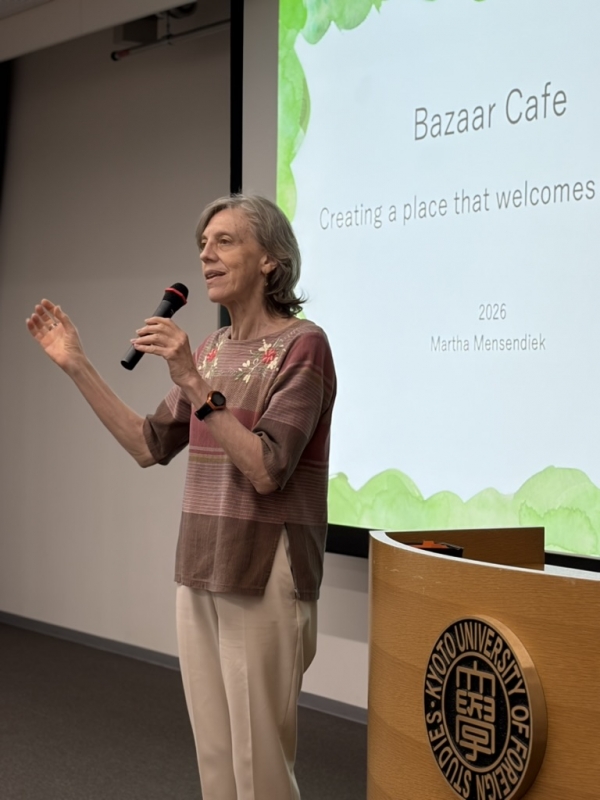 Prof. Mensendiek sharing her personal experiences
-
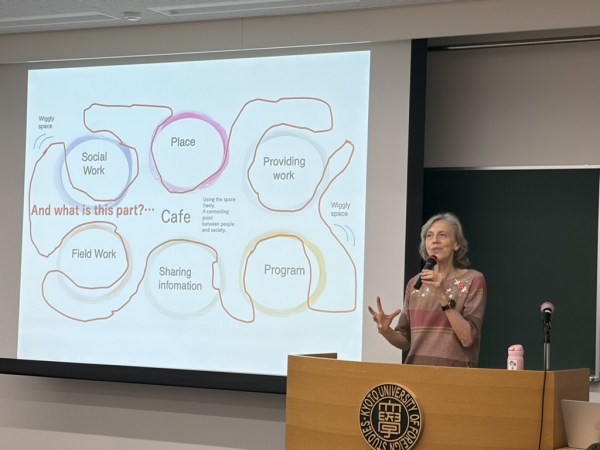 Prof. Mensendiek explaining the concept of 'wiggly space' (うにょうにょ)
-
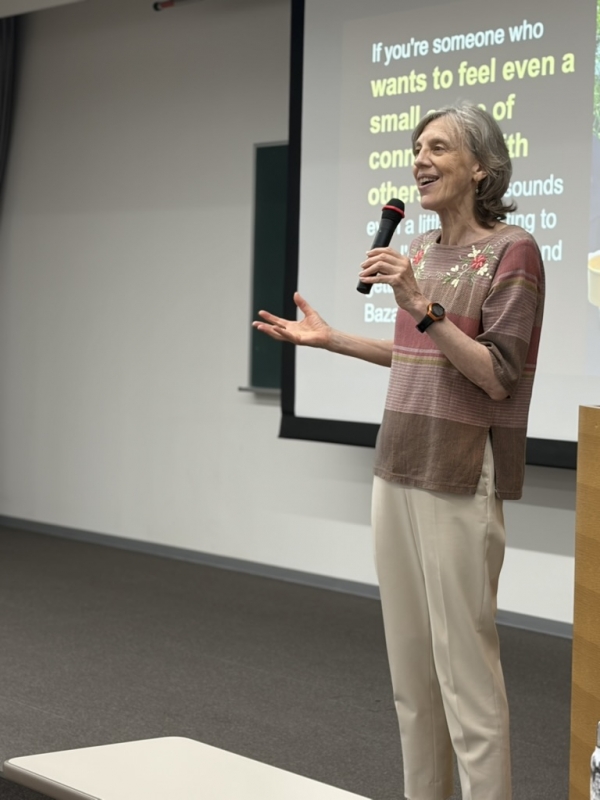 A thoughtful and wholehearted Q&A session with students
2026/07/06 14:50:00 When a Town Becomes a Classroom: Tsuwano as a Place of Learning
- イベント
- Junko Kondo
On 26th June, students in Community Engagement Workshop A welcomed Brendan Barrett as a guest speaker for a lecture titled "Tsuwano: Community as a Place of Learning." Brendan worked with the United Nations for over twenty years and served as a professor at the University of Osaka for eight years. He is currently an adjunct professor at RMIT University's School of Media and Communication.
He began by recounting the story of Tsuwano, a small historic town in Shimane Prefecture with a population of about 6,800. Like many rural communities across Japan, Tsuwano faces rapid population decline and ageing—more than half of its residents are now over 65. Its population peaked at 23,000 in 1955.
He first visited Tsuwano in 2015, at the invitation of colleagues Shinobu Nakanishi (formerly with Dentsu) and Masahiro Tago, whose Edo-period family home urgently needed repair. As they worked on the restoration, a question kept nagging at them: what was the point of saving one house if the town itself was disappearing? Tsuwano is among 896 Japanese communities projected to become non-viable by 2040, according to the politician, Hiroya Masuda.
That question became the starting point for a different kind of initiative. Rather than focusing solely on buildings, they began working with the local high school to organise summer schools and, subsequently, an annual town-wide conference—the Tsuwano Conference—which, in recent years, has centred on the Italian concept of territorio: the interwoven relationship among landscape, culture, history, and food.
One of the most striking moments in the lecture came when Brendan directly provoked the students, walking towards them as he spoke: "Is Japan's vanishing countryside a lost cause, or not?” From there, he described how the annual Tsuwano Conference brings together community engagement practitioners and experts from across Japan and around the world to discuss the town's future alongside local residents and students.
A central theme of the lecture was that, in recent years, the Tsuwano Conference's themes have increasingly converged on practical projects on the ground. The first was the creation of the Tago House Annex (THA), which revitalised a former tourist information office. Today, THA serves as a place where Tsuwano High School students and graduates can return and belong. THA itself offers high school students "a place where they can feel safe, and a place where they can learn." Alongside it, an emerging project called "Tsuwano College" brings together practitioners across food, architecture, townscape, local industry, and communication, as well as anyone curious to learn—setting themes and learning by doing together.
Next, a disused electrical appliance store was renovated to create a riverside café and guesthouse. The café features local produce (territorio) and has become an important venue for the annual Tsuwano Conference. In addition, Tago’s house is being gradually restored and now includes a self-contained apartment for visitors to Tsuwano.
Brendan was direct on this point: tourism is not the only answer. What he has observed through his involvement in Tsuwano is not visitor numbers, but rather how organically local residents connect with people from outside the town—a far slower, more relational process than tourism promotion usually allows.
He also introduced a provocative idea that stayed with students afterwards: that the future may be agrarian—that Japan's future could come to resemble its Edo-period past more than its industrial twentieth century. As students think about how they will engage with regional Japan going forward, this reframing opened up a different set of possible futures to consider.
During the Q&A session, a student from Wakayama Prefecture asked a question close to her own experience: young people often leave rural areas, she suggested, largely because local higher education institutions do not offer what they need—so what did Brendan think the future of university learning would look like? He acknowledged that regional universities in Japan are increasingly facing closures and mergers, but suggested that this very pressure may give rise to creative responses—such as subscription-style access to university lectures by outstanding academics and the opportunity for students to design their own degrees—thereby opening up interesting new possibilities rather than only loss.
What came through most strongly in Brendan’s talk was a sense of collaboration and creativity emerging from crisis, rather than in spite of it. Students left with a deeper understanding of the currents of change shaping the regions they come from, and with encouragement to imagine—and act on—creative responses of their own.
Tsuwano's reimagining of a shrinking town, not as a place that is disappearing but as a "campus" where a new culture of learning can take root, leaves us with rich questions about education and community in an age of polycrisis.
-
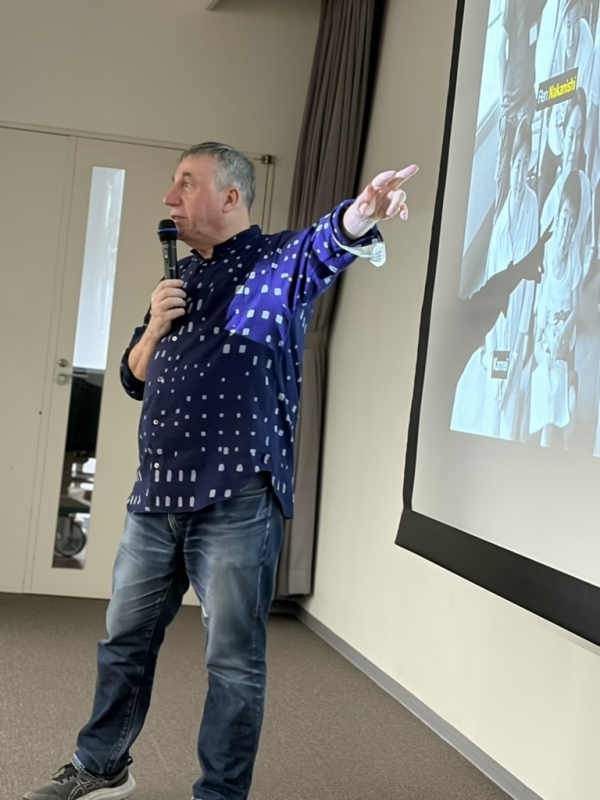 Dr. Barrett introducing his collaborators in Tsuwano
-
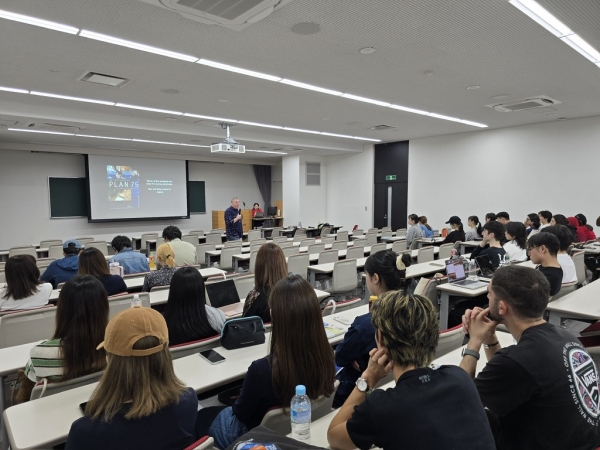 Interactive lecture communicating with students
-
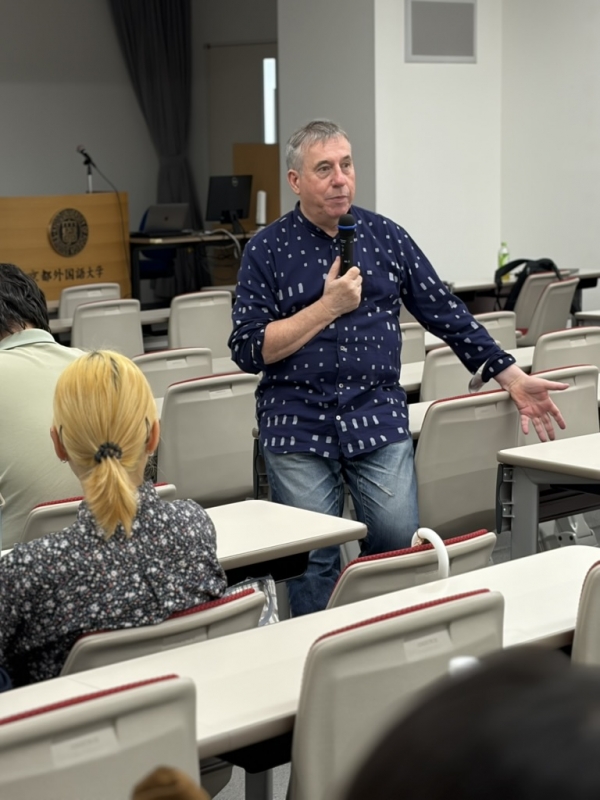 Thought provoking Q and A session
2026/06/23 16:10:00 Sense of Community in Contemporary Japan: A Guest Lecture by Ms. Xiaoling Zhang
- イベント
- Junko Kondo
On June 19th, the Community Engagement Workshop course welcomed Ms. Xiaoling Zhang, field staff at Osugidani Shizen Gakkou (NPO 大杉谷自然学校) in Odai, Mie, for a guest lecture titled "Sense of Community in Contemporary Japan: From a Perspective of Community Rituals and Voluntary Activities." Drawing on her own fieldwork and lived experience in rural Japan, Ms. Zhang led students through a lecture that was equal parts theory, ethnography, and lively discussion.
The lecture opened with the foundational concept of Sense of Community (SOC), defined by McMillan and Chavis as a feeling of belonging, mattering to others, and shared faith that members' needs will be met through commitment to the group. Ms. Zhang walked students through the theory's four core elements — membership, influence, reinforcement, and shared emotional connection — before grounding them in two cultural events she has observed firsthand:
Ise Jingu Okibiki (timber-pulling ceremony) — a 1,300-year-old ritual tied to the rebuilding of Ise Jingu every twenty years, in which local Shinryomin (citizens of the sacred land) pull massive sacred cypress logs by rope. Ms. Zhang highlighted how the ceremony expresses a distinctly Japanese reverence toward nature and the divine.
Obon Odori in Osugi village — a summer festival honoring ancestral spirits that had lapsed for years due to aging and depopulation, but was revived two years ago through community effort. For Ms. Zhang, its revival illustrates how a community born of necessity can also become a community of choice once people choose to keep showing up.
She then extended the discussion to her current work at Osugidani Shizen Gakkou, examining how the NPO builds a sense of community to sustain conservation of the Kumanokodo Iseji, a UNESCO World Heritage pilgrimage route. Through 200km pilgrimage tours and trail maintenance volunteering, Ms. Zhang showed how outsiders — people with no prior tie to the region — can be drawn into a community of necessity and choice at once.
The intellectual high point of the session came when Ms. Zhang posed a question to the class: "Which do you like, or which do you need — Community of Necessity (must), or Community of Choice (will)?"
What followed was a genuinely interactive discussion, with students offering their own experiences and interpretations. One particularly striking response captured the paradox at the heart of the question: in a world where we are now free to choose our communities — fan clubs, hobby groups, online networks — some students argued that we need community of necessity precisely because choice has become so abundant. Without the friction of mutual reliance, they suggested, belonging can become weightless. The discussion was intellectually challenging in the best sense, and students clearly enjoyed thinking out loud together about which kind of community actually sustains them.
The Q&A session was equally rich. Asked for advice on how an international citizen might build trust in a rural Japanese community, Ms. Zhang answered:
"Language is very important — it shows your attitude that you want to learn and commit to the community."
She illustrated this with her own experience learning Thai while living in a rural community in Thailand during her master's studies, and explained that showing genuine curiosity about local tradition and culture was just as important when she joined the Odai community in Japan.
When asked about her personal life principle, Ms. Zhang offered a phrase that resonated widely with students:
"Be a life-learner."
Her own path — born in China, arriving in Japan without language skills, and now fluent in Japanese, English, and Thai after studying across Kyoto, Bangkok, and rural Thailand — gave the principle real weight, and students found her trajectory genuinely inspiring.
What made this session memorable wasn't just the theory of sense of community, but watching it play out in the room itself: students debating necessity versus choice, sharing their own community experiences, and reflecting on what it means to belong somewhere as both insiders and outsiders. For KUFS students — Japanese and international alike — already exploring communities across Japan, Ms. Zhang's lecture offered both a framework and a personal model for how to do that exploration with curiosity and commitment.
-
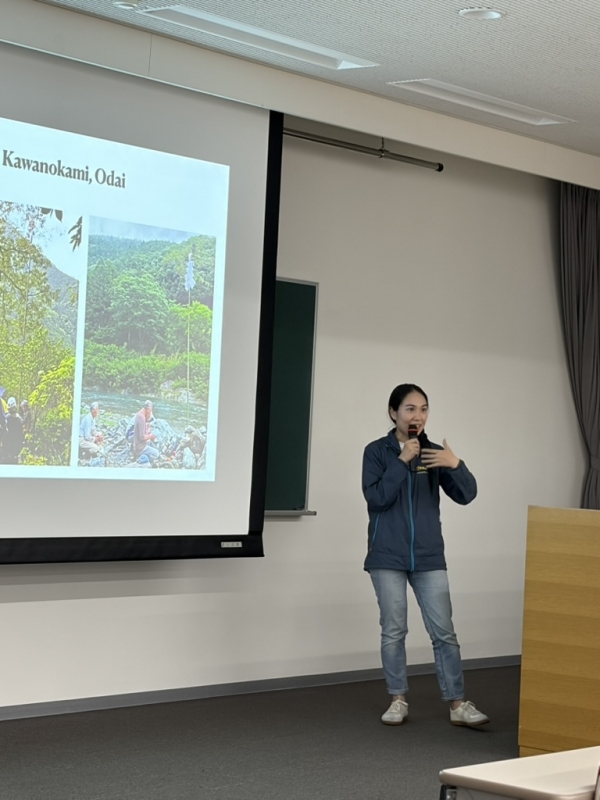 Ms. Zhang introduces beautiful nature in Odai
-
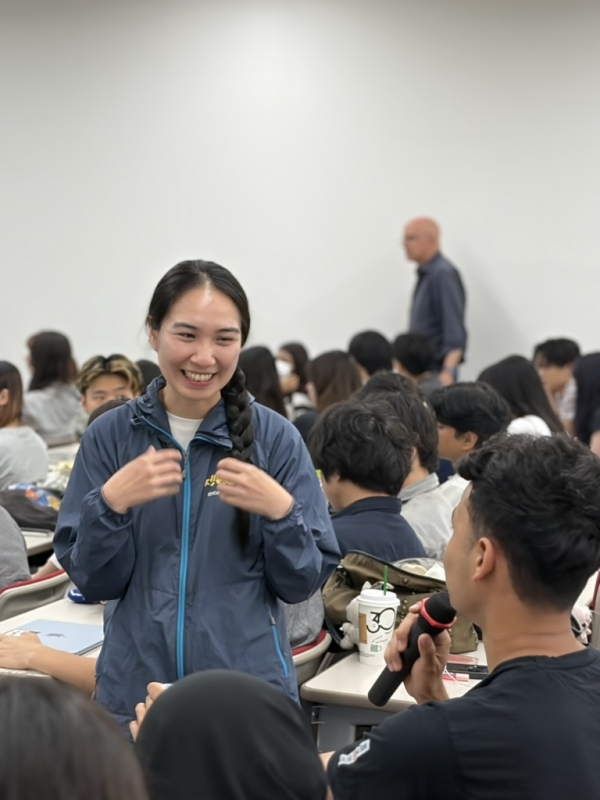 Interactive discussion with students
-
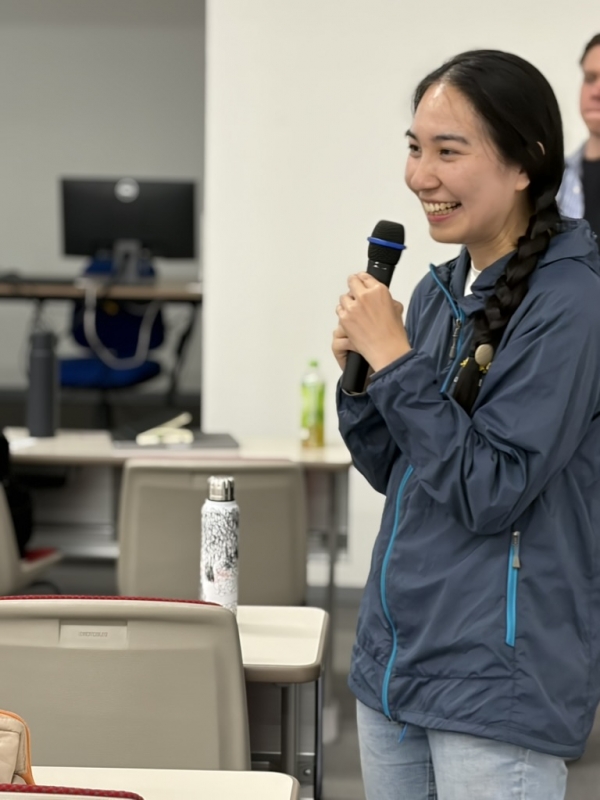 Ms. Zhang wholeheartedly answers questions from students
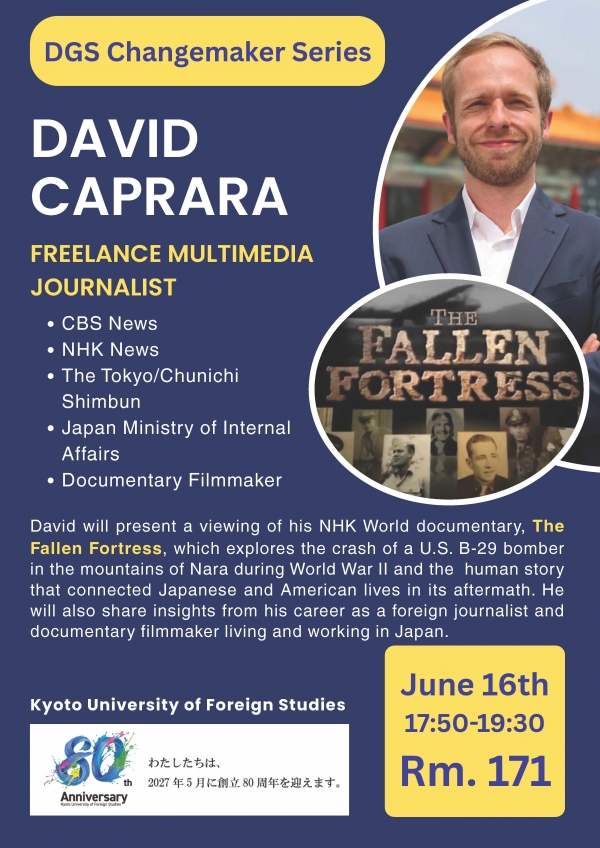
2026/06/18 15:50:00 Changemaker Series Welcomes Journalist and Filmmaker David Caprara on Documentary Storytelling and History
- イベント
- Angus McGregor
David Caprara, a freelance multimedia journalist and documentary filmmaker, spoke to students in the Department of Global Studies on June 16 as part of the department’s Changemaker Series. Caprara shared his journey to becoming an international journalist based in the Kansai region and discussed how his passion for storytelling led him into documentary filmmaking. He also screened and discussed his 2021 documentary, The Fallen Fortress, which examines the story of an American B-29 bomber that crashed in the mountains of Nara following a bombing raid on Osaka during World War II.
Throughout his career, Caprara has produced news packages and documentaries focusing on culture and politics in Japan and the broader Asia-Pacific region. He shared stories from his early experiences in “bootstrap” journalism, explaining how he launched his career by traveling independently to global hotspots to report on developing events. These experiences led to first-hand reporting on the 2015 Nepal earthquake, protests along the India-Nepal border, and the de facto refugee camps that emerged across Greece during the Syrian Civil War and refugee crisis.
These experiences eventually opened opportunities with established media organizations, including the Tokyo bureau of CBS News, the New York bureaus of NHK and The Tokyo Shimbun, and NHK World, where he worked as an on-camera correspondent.
Caprara has also directed and produced numerous documentaries, including The Honey Hunters of Nepal, which received a Webby Award in 2017, and Horimono: Japan’s Tattoo Pilgrimage, which was screened at international film festivals around the world. His most recent project, The Fallen Fortress, follows the human tragedy surrounding a crashed B-29 bomber and the surviving crew members who parachuted onto Mt. Omine, a Buddhist holy mountain in Nara.
In the film, he interviews local residents who either witnessed the surviving airmen arriving in their villages or grew up hearing stories about the incident. He also speaks with relatives of the American airmen, uncovering new information that offers insight—and in some cases a measure of closure—to families who had long known only that their loved ones were listed as missing in action. Through these personal stories, the documentary explores the lasting human impact of war on both sides of the conflict.
Following the presentation and film screening, DGS students asked questions ranging from the challenges of interviewing people about emotionally difficult subjects to practical advice on conducting relevant and meaningful historical research. Students also noted how effectively the documentary balanced the perspectives of Japanese communities affected by the bombing campaign and the American airmen who became prisoners of war. Without taking sides or assigning blame, Caprara’s film communicates the tragic human cost of war and the enduring impact it has on individuals, families, and communities.
Following the DGS event, Caprara generously offered additional time to meet with visiting journalism students from U.S. universities participating in the ieiMedia study abroad program, an intensive journalism course that travels to international destinations around the world. The ten students and their two faculty members engaged in a more focused discussion on journalism, documentary filmmaking, and international reporting. Drawing on his own career experiences, Caprara offered practical advice to aspiring journalists and storytellers while emphasizing the importance of curiosity, persistence, and human-centered reporting.
Through both sessions, students gained valuable insight into the role of journalism and documentary filmmaking in preserving historical memory and fostering cross-cultural understanding—an objective that aligns closely with the goals of the Department of Global Studies’ Changemaker Series.
-
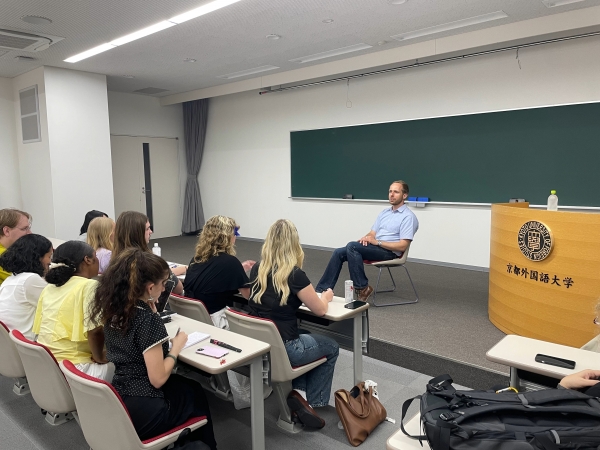 David Caprara discusses storytelling and history
-
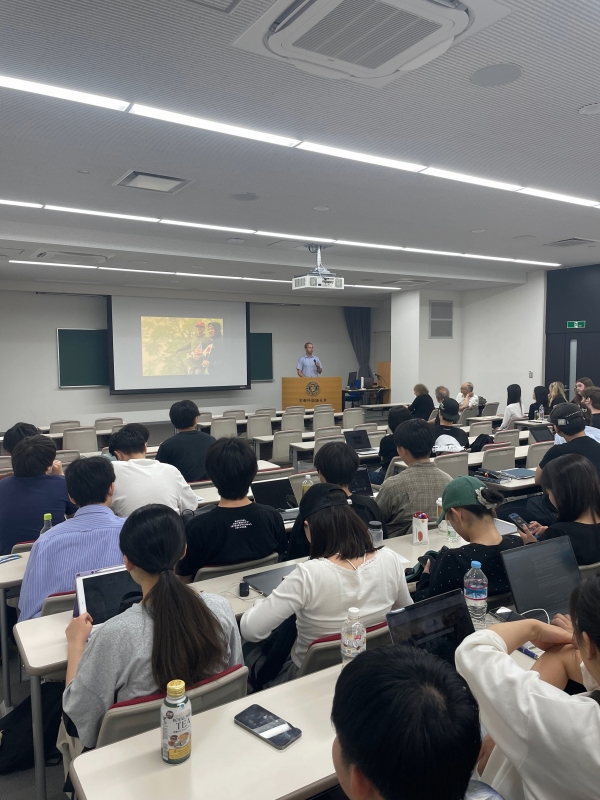 Lively audience Q and A
-
2026/06/08 13:30:00 Community Engagement Workshop A – Guest Lecture by Tomo Hitomi (SISAM Inc.) フェアトレードとエシカル消費を学ぶ
- イベント
- Junko Kondo
On May 22nd, students in Community Engagement Workshop A had the opportunity to learn from Tomo Hitomi, director of Kyoto-based fair trade brand SISAM Inc..
Ms. Hitomi shared insights from nearly 30 years of experience working in the field of fair trade. One of the most memorable aspects of the lecture was how interactive the session was. Instead of only listening passively, students were constantly invited to reflect on their own everyday lives and consumption habits.
At the beginning of the lecture, Ms. Hitomi asked the class a simple but powerful question: “How many of you know who made the clothes you are wearing today?” Surprisingly, Ms. Hitomi herself was the only person in the room who could answer confidently. She shared that the beautiful skirt she was wearing had been made by women in India whose faces and stories she personally knew through her fair trade work. This moment left a strong impression on many students, highlighting how disconnected modern consumers often are from the people behind the products they use every day. Her story transformed clothing from a simple fashion item into something deeply connected to human relationships, dignity, and global interdependence.
She also asked students to check the tags on their own clothes and think about where their clothing was made. This simple activity immediately connected global issues to students’ personal lives. She also encouraged students to reflect on what they usually prioritize when buying clothes:
Price
Design or materials
Whether the product is environmentally friendly
Whether human rights are respected in the production process
She further challenged students by asking how consumers can actually verify whether companies are environmentally responsible or respectful of human rights. Through active discussion between her and the students, the classroom gradually dove deeper into the complex world of fair trade, ethical consumption, and global supply chains. Many students appeared to rethink their perspectives by the end of the lecture.
One of the most impactful parts of the lecture was her discussion of the Rana Plaza collapse. Many students were shocked to realize how closely global labor exploitation is connected to familiar fast fashion brands that we encounter in our everyday lives. The talk encouraged students to reconsider the hidden human stories behind inexpensive products and mass consumption.
Ms. Hitomi also introduced the inspiring work of Creative Handicrafts, a women-led organization in India. Rather than focusing only on vocational training, the organization supports women holistically by providing self-defense education, emotional support, and opportunities to regain a sense of dignity and self-worth. She explained that fair trade is “more than fair prices” – it is about caring for people and creating environments where individuals can live with dignity.
Another eye-opening point was her reflection that gender inequality is not only an issue in developing countries. She noted that Japan also continues to struggle with gender gaps and social inequalities. In this sense, fair trade does not only “empower women overseas”; it can also empower consumers and communities in Japan to rethink the kind of society they wish to create.
Throughout the lecture, She repeatedly emphasized the message: “What you buy is what you vote.” She encouraged students to recognize that money has power, and that everyday purchasing decisions can shape society. By choosing products rooted in ethical values, consumers can contribute to building a more compassionate and sustainable world.
She concluded the lecture with the message: “You can be a changemaker.” According to Ms. Hitomi, becoming a changemaker can begin with three simple actions: knowing, buying, and spreading the philosophy of fair trade. This message strongly resonated with many students in the Department of Global Studies, where “Be a Changemaker” is also a familiar guiding idea.
During the Q&A session, one student asked Ms. Hitomi what inspired her to enter the fair trade industry. In response, she shared a powerful personal story from her university days, when she participated in an internship in Thailand. There, she witnessed severe issues of human trafficking in rural communities, where young women were often sold due to poverty and lack of opportunity. However, she also encountered a village engaged in fair trade practices, and she noticed a striking difference: the women in that community had greater stability, dignity, and protection from exploitation. This experience deeply moved her and convinced her of the transformative potential of fair trade.
The lecture offered students not only knowledge about global issues, but also a hopeful perspective on how small everyday actions can contribute to meaningful social change.
Thank you very much, Ms. Hitomi, for your inspiring and thought-provoking talk.
-
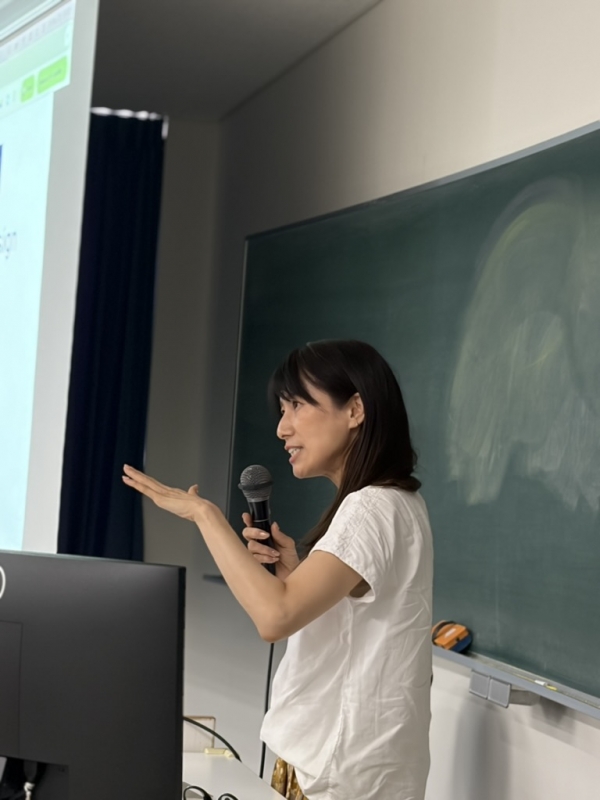 Ms. Hitomi explaining the philosophy behind SISAM and fair trade
-
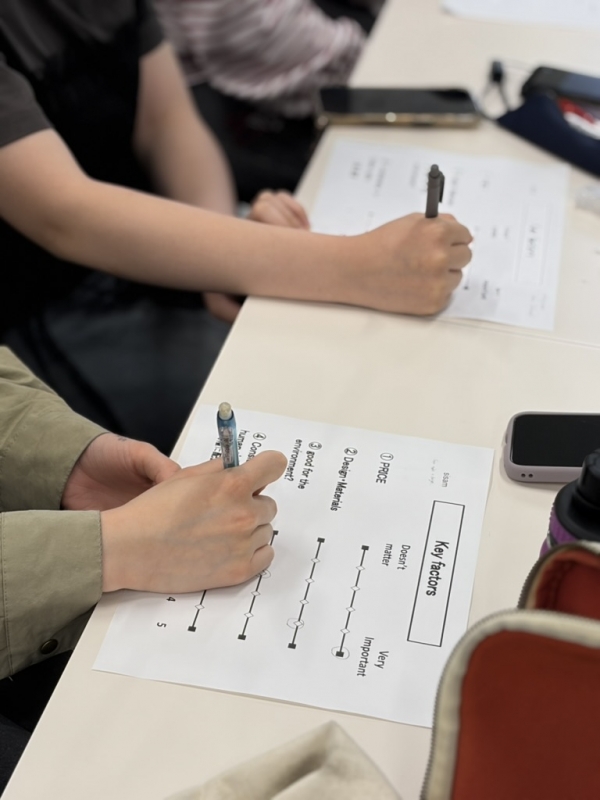 Students reflecting on what they usually prioritize when buying clothes
-
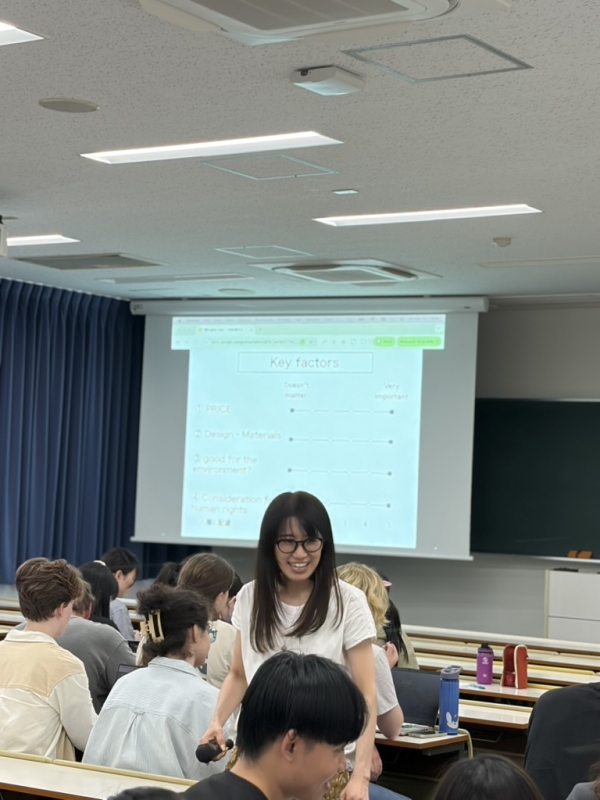 Interactive discussion and exchange of ideas between students and Ms. Hitomi


