


2026/07/07 14:20:00 Finding Belonging in the "Wiggly Space": A Guest Lecture on Bazaar Café
 イベント
 Junko Kondo
On July 3rd, Community Engagement Workshop A welcomed Professor Martha Mensendiek of Doshisha University's Department of Social Welfare, who is also the representative of Bazaar Café. Located near Doshisha University, Bazaar Café began as a project between the Kyoto district of the United Church of Christ in Japan and a group of artists, university faculty, missionaries, and pastors. Its founding aim was to create a space where people living very different realities — across sexuality, age, and nationality — could be accepted as they are, where each person's values are respected. Bazaar Café also provides employment to foreign residents of Japan and others who, for various reasons, find it difficult to access work.
The lecture began with her personal experience growing up in Japan with a US background, and her enthusiasm for supporting diverse people with various backgrounds in Japanese society. As she noted — and as we observe today — Japanese society sometimes insists on homogeneity and shows xenophobia, and Bazaar Café is one of the places providing a safe space within a society inclined toward homogeneity, welcoming people regardless of their “labels” in the society. Bazaar Café does not organize itself around fixed identities or social categories. Instead, it is built on three guiding principles: respecting anonymity, valuing relationships that are not fixed in advance, and creating a space where everyone simply belongs.
One idea that particularly captured students' attention was what Prof. Mensendiek called the "wiggly space"— うにょうにょ. Bazaar Café officially performs several functions: social work, providing a physical place, offering employment, hosting university students for fieldwork, sharing information, and organizing community programs and events. But between each of these defined functions lies an undefined, flexible margin — the wiggly space — where nothing in particular is required of anyone. It is in this in-between space, she explained, that people are free to simply mingle, linger, and “be”. The café's quiet message to everyone who walks in is: "It's okay just to be." No task, no diagnosis, no role to perform — just presence.
Prof. Mensendiek shared a story that moved many students deeply. It was about a man who, for years, had lived in profound social isolation, cycling through hospitalization and incarceration. Over time, people at Bazaar Café simply kept showing up for him — not to fix or instruct him, but to accompany him. Some went with him to court. Some sat in on his case conferences. Some visited him in the hospital. Some smoked cigarettes with him, and one New Year's Eve, some shared a bowl of soba noodles together. When he passed away, Prof. Mensendiek said, he was not lonely.
She reflected that Bazaar Café's way of supporting people is not to give instructions or corrective guidance, but simply to be by someone's side — regardless of addiction, illness, or whatever social difficulty they carry. It is this steady, unconditional presence, she suggested, that allows a genuine space of sharing to emerge: a place where people can feel a true sense of belonging, and perhaps rediscover meaning in their own lives.
Following the lecture, two third-year seminar students who volunteered at Bazaar Café last year as part of Community Engagement Workshop B shared their reflections with the class.
> "No two people at Bazaar are alike — and that's true in our everyday lives as well. No one shares the exact same past or future; everyone lives day to day with their own thoughts, hopes, goals, and experiences. Yet I felt that this is a place where you can really sense how such different people join hands and support one another, helping each other get through each day. (...) I learned through this experience the importance of recognizing that everyone has a past, of accepting that past, and of truly seeing a person's heart and character."
> "I came to see that Bazaar Café is a place that creates a space of belonging for people like this. Whenever I went, everyone at Bazaar Café treated me warmly too, and it became a place of belonging for me as well. If you're someone who wants to feel even a small sense of connection with others, or if this sounds even a little interesting to you, I'd really recommend getting involved with Bazaar Café."
The session closed with a warm and thoughtful Q&A, as students asked Prof. Mensendiek about challenges, financial management, language for volunteers, and religious openness as part of the Church's activities and future goals of the café etc., showing their deep interest.
Thank you, Prof. Mensendiek, for the thought-provoking and wholehearted lecture. We are sure that the time we spent in class will help us find a home that warmly welcomes every part of ourselves, and the people by our side.
-
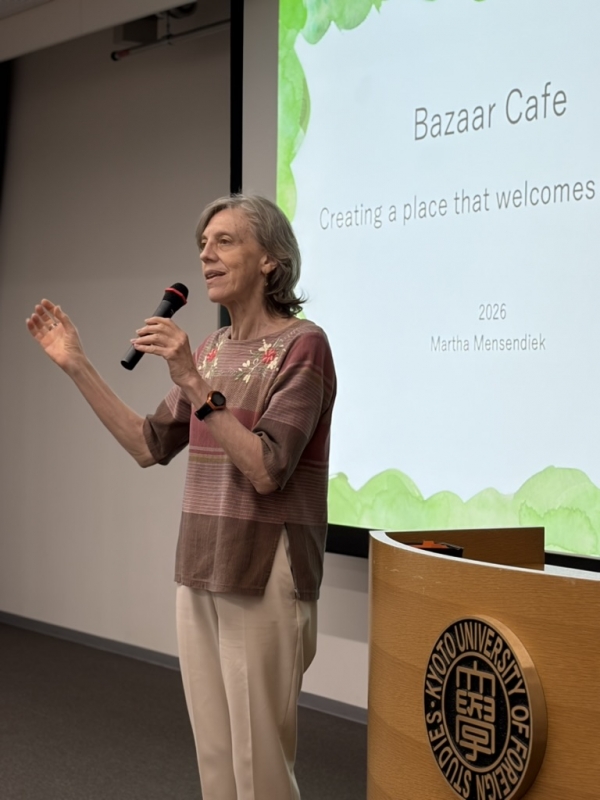 Prof. Mensendiek sharing her personal experiences
-
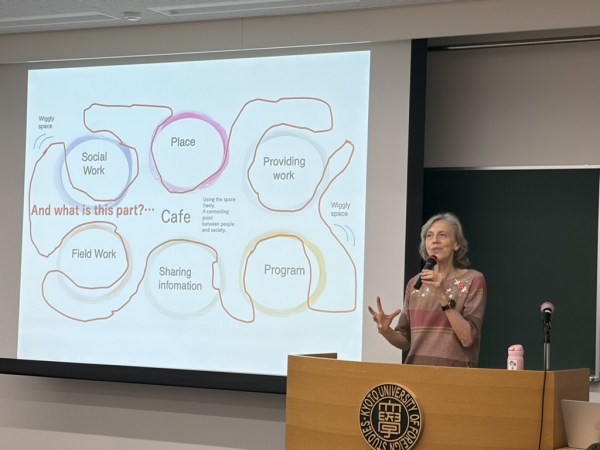 Prof. Mensendiek explaining the concept of 'wiggly space' (うにょうにょ)
-
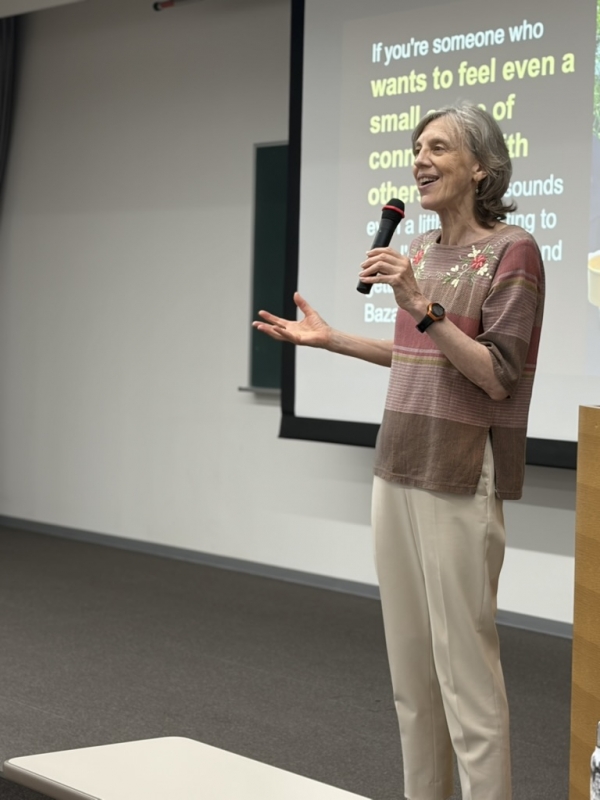 A thoughtful and wholehearted Q&A session with students


