


2026/07/06 14:50:00 When a Town Becomes a Classroom: Tsuwano as a Place of Learning
 イベント
 Junko Kondo
On 26th June, students in Community Engagement Workshop A welcomed Brendan Barrett as a guest speaker for a lecture titled "Tsuwano: Community as a Place of Learning." Brendan worked with the United Nations for over twenty years and served as a professor at the University of Osaka for eight years. He is currently an adjunct professor at RMIT University's School of Media and Communication.
He began by recounting the story of Tsuwano, a small historic town in Shimane Prefecture with a population of about 6,800. Like many rural communities across Japan, Tsuwano faces rapid population decline and ageing—more than half of its residents are now over 65. Its population peaked at 23,000 in 1955.
He first visited Tsuwano in 2015, at the invitation of colleagues Shinobu Nakanishi (formerly with Dentsu) and Masahiro Tago, whose Edo-period family home urgently needed repair. As they worked on the restoration, a question kept nagging at them: what was the point of saving one house if the town itself was disappearing? Tsuwano is among 896 Japanese communities projected to become non-viable by 2040, according to the politician, Hiroya Masuda.
That question became the starting point for a different kind of initiative. Rather than focusing solely on buildings, they began working with the local high school to organise summer schools and, subsequently, an annual town-wide conference—the Tsuwano Conference—which, in recent years, has centred on the Italian concept of territorio: the interwoven relationship among landscape, culture, history, and food.
One of the most striking moments in the lecture came when Brendan directly provoked the students, walking towards them as he spoke: "Is Japan's vanishing countryside a lost cause, or not?” From there, he described how the annual Tsuwano Conference brings together community engagement practitioners and experts from across Japan and around the world to discuss the town's future alongside local residents and students.
A central theme of the lecture was that, in recent years, the Tsuwano Conference's themes have increasingly converged on practical projects on the ground. The first was the creation of the Tago House Annex (THA), which revitalised a former tourist information office. Today, THA serves as a place where Tsuwano High School students and graduates can return and belong. THA itself offers high school students "a place where they can feel safe, and a place where they can learn." Alongside it, an emerging project called "Tsuwano College" brings together practitioners across food, architecture, townscape, local industry, and communication, as well as anyone curious to learn—setting themes and learning by doing together.
Next, a disused electrical appliance store was renovated to create a riverside café and guesthouse. The café features local produce (territorio) and has become an important venue for the annual Tsuwano Conference. In addition, Tago’s house is being gradually restored and now includes a self-contained apartment for visitors to Tsuwano.
Brendan was direct on this point: tourism is not the only answer. What he has observed through his involvement in Tsuwano is not visitor numbers, but rather how organically local residents connect with people from outside the town—a far slower, more relational process than tourism promotion usually allows.
He also introduced a provocative idea that stayed with students afterwards: that the future may be agrarian—that Japan's future could come to resemble its Edo-period past more than its industrial twentieth century. As students think about how they will engage with regional Japan going forward, this reframing opened up a different set of possible futures to consider.
During the Q&A session, a student from Wakayama Prefecture asked a question close to her own experience: young people often leave rural areas, she suggested, largely because local higher education institutions do not offer what they need—so what did Brendan think the future of university learning would look like? He acknowledged that regional universities in Japan are increasingly facing closures and mergers, but suggested that this very pressure may give rise to creative responses—such as subscription-style access to university lectures by outstanding academics and the opportunity for students to design their own degrees—thereby opening up interesting new possibilities rather than only loss.
What came through most strongly in Brendan’s talk was a sense of collaboration and creativity emerging from crisis, rather than in spite of it. Students left with a deeper understanding of the currents of change shaping the regions they come from, and with encouragement to imagine—and act on—creative responses of their own.
Tsuwano's reimagining of a shrinking town, not as a place that is disappearing but as a "campus" where a new culture of learning can take root, leaves us with rich questions about education and community in an age of polycrisis.
-
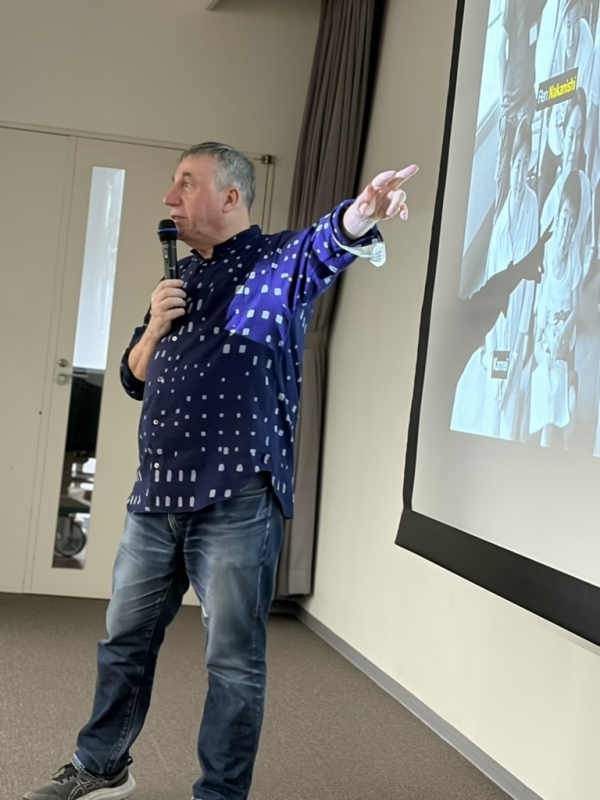 Dr. Barrett introducing his collaborators in Tsuwano
-
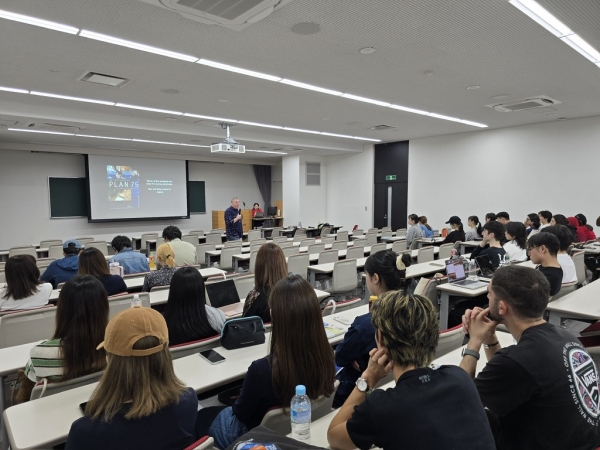 Interactive lecture communicating with students
-
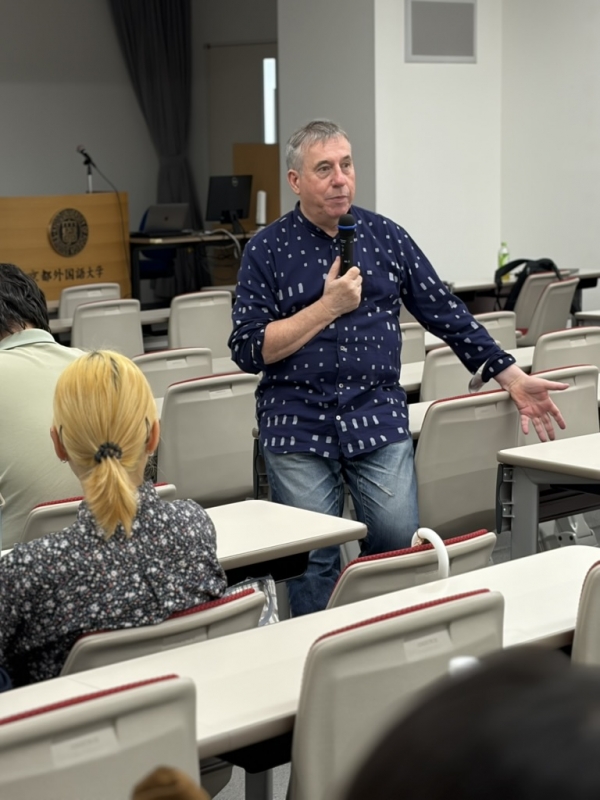 Thought provoking Q and A session


