


2026/06/23 16:10:00 Sense of Community in Contemporary Japan: A Guest Lecture by Ms. Xiaoling Zhang
 イベント
 Junko Kondo
On June 19th, the Community Engagement Workshop course welcomed Ms. Xiaoling Zhang, field staff at Osugidani Shizen Gakkou (NPO 大杉谷自然学校) in Odai, Mie, for a guest lecture titled "Sense of Community in Contemporary Japan: From a Perspective of Community Rituals and Voluntary Activities." Drawing on her own fieldwork and lived experience in rural Japan, Ms. Zhang led students through a lecture that was equal parts theory, ethnography, and lively discussion.
The lecture opened with the foundational concept of Sense of Community (SOC), defined by McMillan and Chavis as a feeling of belonging, mattering to others, and shared faith that members' needs will be met through commitment to the group. Ms. Zhang walked students through the theory's four core elements — membership, influence, reinforcement, and shared emotional connection — before grounding them in two cultural events she has observed firsthand:
Ise Jingu Okibiki (timber-pulling ceremony) — a 1,300-year-old ritual tied to the rebuilding of Ise Jingu every twenty years, in which local Shinryomin (citizens of the sacred land) pull massive sacred cypress logs by rope. Ms. Zhang highlighted how the ceremony expresses a distinctly Japanese reverence toward nature and the divine.
Obon Odori in Osugi village — a summer festival honoring ancestral spirits that had lapsed for years due to aging and depopulation, but was revived two years ago through community effort. For Ms. Zhang, its revival illustrates how a community born of necessity can also become a community of choice once people choose to keep showing up.
She then extended the discussion to her current work at Osugidani Shizen Gakkou, examining how the NPO builds a sense of community to sustain conservation of the Kumanokodo Iseji, a UNESCO World Heritage pilgrimage route. Through 200km pilgrimage tours and trail maintenance volunteering, Ms. Zhang showed how outsiders — people with no prior tie to the region — can be drawn into a community of necessity and choice at once.
The intellectual high point of the session came when Ms. Zhang posed a question to the class: "Which do you like, or which do you need — Community of Necessity (must), or Community of Choice (will)?"
What followed was a genuinely interactive discussion, with students offering their own experiences and interpretations. One particularly striking response captured the paradox at the heart of the question: in a world where we are now free to choose our communities — fan clubs, hobby groups, online networks — some students argued that we need community of necessity precisely because choice has become so abundant. Without the friction of mutual reliance, they suggested, belonging can become weightless. The discussion was intellectually challenging in the best sense, and students clearly enjoyed thinking out loud together about which kind of community actually sustains them.
The Q&A session was equally rich. Asked for advice on how an international citizen might build trust in a rural Japanese community, Ms. Zhang answered:
"Language is very important — it shows your attitude that you want to learn and commit to the community."
She illustrated this with her own experience learning Thai while living in a rural community in Thailand during her master's studies, and explained that showing genuine curiosity about local tradition and culture was just as important when she joined the Odai community in Japan.
When asked about her personal life principle, Ms. Zhang offered a phrase that resonated widely with students:
"Be a life-learner."
Her own path — born in China, arriving in Japan without language skills, and now fluent in Japanese, English, and Thai after studying across Kyoto, Bangkok, and rural Thailand — gave the principle real weight, and students found her trajectory genuinely inspiring.
What made this session memorable wasn't just the theory of sense of community, but watching it play out in the room itself: students debating necessity versus choice, sharing their own community experiences, and reflecting on what it means to belong somewhere as both insiders and outsiders. For KUFS students — Japanese and international alike — already exploring communities across Japan, Ms. Zhang's lecture offered both a framework and a personal model for how to do that exploration with curiosity and commitment.
-
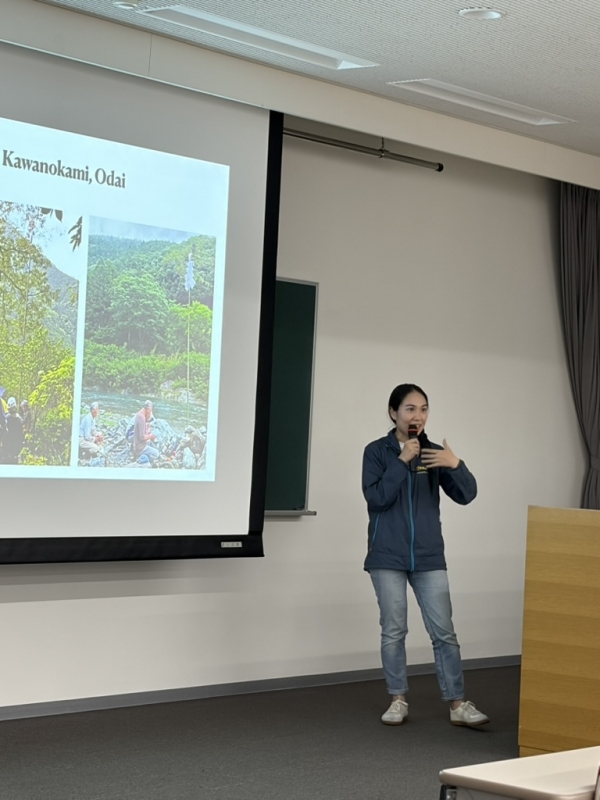 Ms. Zhang introduces beautiful nature in Odai
-
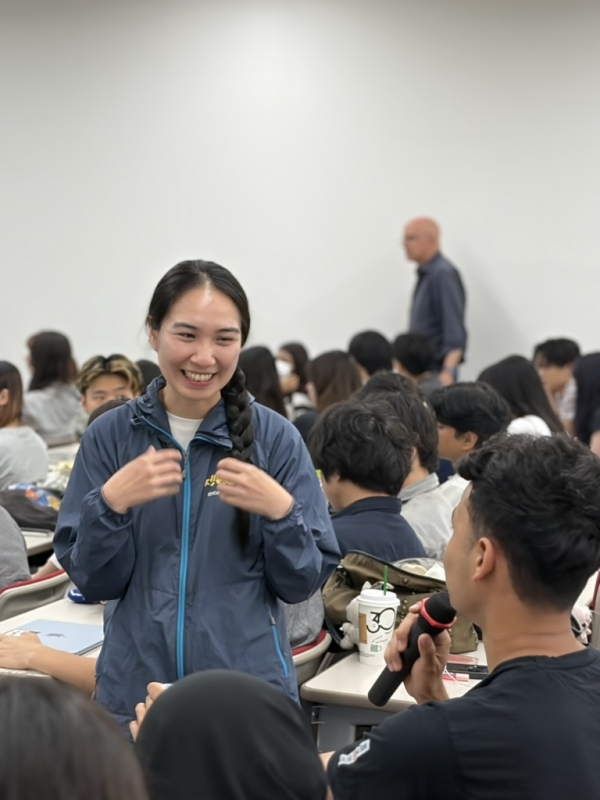 Interactive discussion with students
-
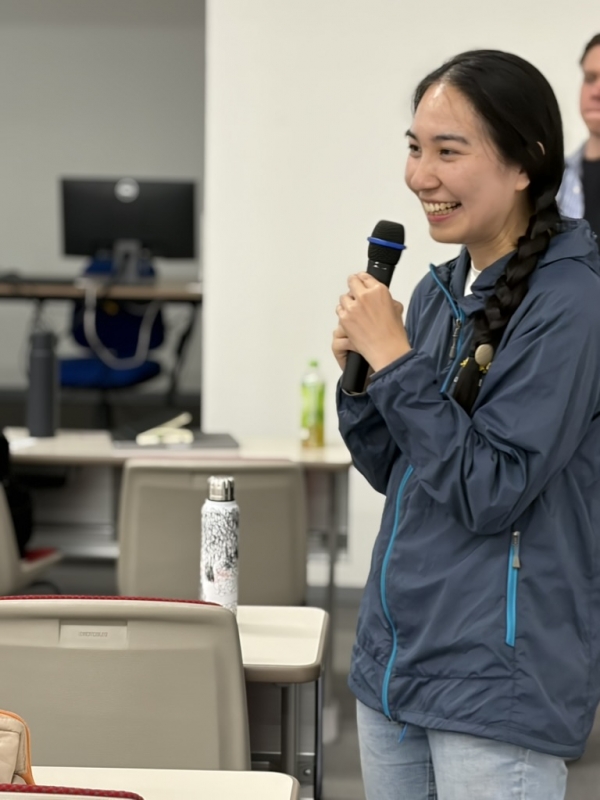 Ms. Zhang wholeheartedly answers questions from students
2026/06/18 15:50:00 Changemaker Series Welcomes Journalist and Filmmaker David Caprara on Documentary Storytelling and History
- イベント
- Angus McGregor
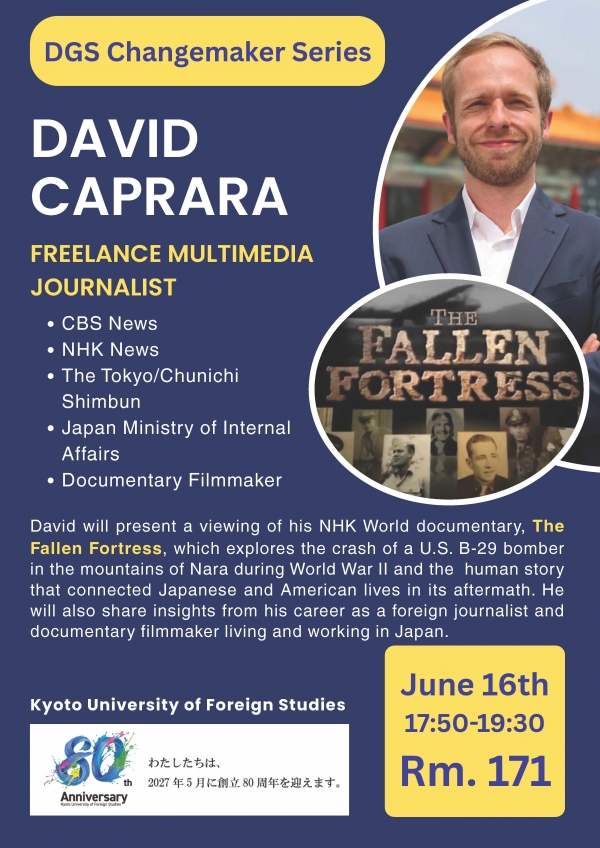
David Caprara, a freelance multimedia journalist and documentary filmmaker, spoke to students in the Department of Global Studies on June 16 as part of the department’s Changemaker Series. Caprara shared his journey to becoming an international journalist based in the Kansai region and discussed how his passion for storytelling led him into documentary filmmaking. He also screened and discussed his 2021 documentary, The Fallen Fortress, which examines the story of an American B-29 bomber that crashed in the mountains of Nara following a bombing raid on Osaka during World War II.
Throughout his career, Caprara has produced news packages and documentaries focusing on culture and politics in Japan and the broader Asia-Pacific region. He shared stories from his early experiences in “bootstrap” journalism, explaining how he launched his career by traveling independently to global hotspots to report on developing events. These experiences led to first-hand reporting on the 2015 Nepal earthquake, protests along the India-Nepal border, and the de facto refugee camps that emerged across Greece during the Syrian Civil War and refugee crisis.
These experiences eventually opened opportunities with established media organizations, including the Tokyo bureau of CBS News, the New York bureaus of NHK and The Tokyo Shimbun, and NHK World, where he worked as an on-camera correspondent.
Caprara has also directed and produced numerous documentaries, including The Honey Hunters of Nepal, which received a Webby Award in 2017, and Horimono: Japan’s Tattoo Pilgrimage, which was screened at international film festivals around the world. His most recent project, The Fallen Fortress, follows the human tragedy surrounding a crashed B-29 bomber and the surviving crew members who parachuted onto Mt. Omine, a Buddhist holy mountain in Nara.
In the film, he interviews local residents who either witnessed the surviving airmen arriving in their villages or grew up hearing stories about the incident. He also speaks with relatives of the American airmen, uncovering new information that offers insight—and in some cases a measure of closure—to families who had long known only that their loved ones were listed as missing in action. Through these personal stories, the documentary explores the lasting human impact of war on both sides of the conflict.
Following the presentation and film screening, DGS students asked questions ranging from the challenges of interviewing people about emotionally difficult subjects to practical advice on conducting relevant and meaningful historical research. Students also noted how effectively the documentary balanced the perspectives of Japanese communities affected by the bombing campaign and the American airmen who became prisoners of war. Without taking sides or assigning blame, Caprara’s film communicates the tragic human cost of war and the enduring impact it has on individuals, families, and communities.
Following the DGS event, Caprara generously offered additional time to meet with visiting journalism students from U.S. universities participating in the ieiMedia study abroad program, an intensive journalism course that travels to international destinations around the world. The ten students and their two faculty members engaged in a more focused discussion on journalism, documentary filmmaking, and international reporting. Drawing on his own career experiences, Caprara offered practical advice to aspiring journalists and storytellers while emphasizing the importance of curiosity, persistence, and human-centered reporting.
Through both sessions, students gained valuable insight into the role of journalism and documentary filmmaking in preserving historical memory and fostering cross-cultural understanding—an objective that aligns closely with the goals of the Department of Global Studies’ Changemaker Series.
-
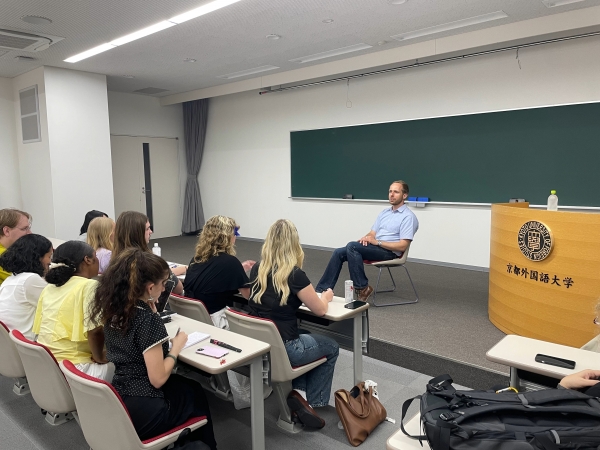 David Caprara discusses storytelling and history
-
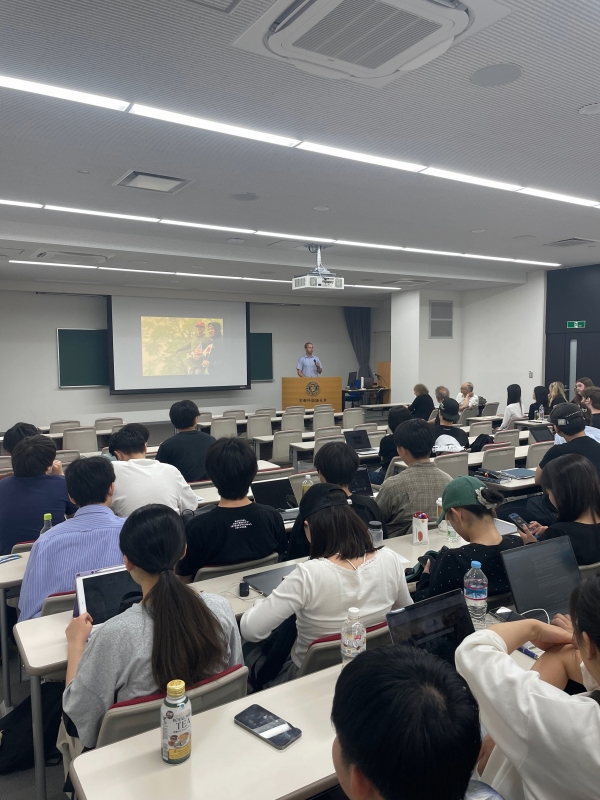 Lively audience Q and A
-
2026/06/13 17:10:00 From Shopping Streets to Learning Streets: Becoming the “Sazae-san” of Your Community
- お知らせ
- Junko Kondo
On June 5, we had the pleasure of welcoming Kanami Iwata, a proud alumna of Kyoto University of Foreign Studies (KUFS) and a community manager based in Kobe, as a guest speaker for our Community Engagement Workshop course.
Kanami-san is someone who truly embodies the spirit of community engagement. Through her work in Kobe’s Suido-suji Shopping Street and surrounding neighborhoods, she demonstrated how ordinary people can become extraordinary changemakers by connecting people, ideas, and opportunities.
At the beginning of the lecture, Kanami-san asked us a simple question: “Do you know the job called a Parallel Community Coordinator?” No one could answer. Then she smiled and said: “I know you don’t know it. Because I created this job myself.” She continued: “You can create your job on your own.” This was a powerful message, especially coming from a KUFS graduate. Rather than fitting herself into an existing occupation, Kanami-san identified a social need and designed a role around it. Her story reminded us that meaningful careers are not always found, they can also be created.
Kanami-san introduced us to her organization, Tamago Koen (Egg Park). The name was inspired by Oji Koen (Oji Park), a well-known park in her neighborhood. In Japanese, the characters for Tamago (egg) and Oji look surprisingly similar, differing by only a small additional stroke. While she presented this as a humorous wordplay, the idea behind the name carries a deeper meaning. An egg symbolizes potential. It is a place where new life develops and hatches. Similarly, Tamago Koen aims to become a space where people’s ideas can emerge, grow, and take flight. Their vision is to make the city feel like a park, a place where everyone feels welcome, safe, and able to belong.
One of the most memorable concepts from the lecture was the role of the “Sazae-san” of the community. Drawing on the familiar Japanese cartoon character known for her warmth, friendliness, and involvement in neighborhood life, Kanami-san described herself as a person who informally connects residents, shop owners, students, local government officials, and community organizations. Her role is not to lead from above but to listen carefully to people’s needs and aspirations.By creating opportunities for collaboration, organizing events, and introducing people to one another, she lowers the barriers to participation and helps build a stronger sense of community.
During the Q&A session, a student asked what motivated her to become a community coordinator. Her answer was both honest and inspiring: “I don’t have any special skill, so I thought I can connect skillful people.” Many people might view the lack of a specialized expertise as a weakness. Kanami-san transformed it into a strength. She recognized that communities need connectors as much as they need experts. In many ways, she serves as a cultural translator, someone who helps different people understand one another and work together. However, she was also candid about the difficulties of this role. “Listening to people and connecting people who each have different paces, speeds, and tones is very difficult.”
When asked about the personal benefits of her work, Kanami-san gave an answer:. “Everyone knows me and they care about me.” She shared a simple example: when she changes her hair color and walks down the street, people immediately notice and comment on it. In contemporary Japan, where many people experience isolation and anonymity, this kind of everyday recognition is increasingly rare.
Kanami-san also invited students to participate in some of her ongoing projects. For example, she is looking for volunteers to support activities such as English-language guiding and translation for the Suido-suji Tasting Tour. These projects provide valuable opportunities for students to apply their language skills while engaging with local communities. They may also serve as excellent Community Engagement activities for students participating in Community Engagement Workshop B during the fall semester.
Kanami-san concluded with a massage holding a particularly special meaning for her: “Opportunities knock, but you are the one who opens the door.” She explained that these were words a professor told her during her time as a KUFS student. The phrase stayed with her throughout her university years and beyond, becoming a guiding principle in her life and career. In many ways, Kanami-san now embodies the very lesson that once inspired her as a student. Her lecture offered more than an introduction to community development. It showed us a living example of what it means to be a changemaker.
Thank you, Kanami-san, for sharing your experiences and inspiring us through your warmth, humility, and commitment to connecting people. Your work demonstrates how communities become stronger when someone is willing to listen, care, and create opportunities for others.
-
 Kanami-san engaging students with a question
-
 Kanami-san introducing the city of Kobe and the communities she works with
-
 Students taking notes on the flyers shared by Kanami-san
2026/06/08 13:30:00 Community Engagement Workshop A – Guest Lecture by Tomo Hitomi (SISAM Inc.) フェアトレードとエシカル消費を学ぶ
- イベント
- Junko Kondo
On May 22nd, students in Community Engagement Workshop A had the opportunity to learn from Tomo Hitomi, director of Kyoto-based fair trade brand SISAM Inc..
Ms. Hitomi shared insights from nearly 30 years of experience working in the field of fair trade. One of the most memorable aspects of the lecture was how interactive the session was. Instead of only listening passively, students were constantly invited to reflect on their own everyday lives and consumption habits.
At the beginning of the lecture, Ms. Hitomi asked the class a simple but powerful question: “How many of you know who made the clothes you are wearing today?” Surprisingly, Ms. Hitomi herself was the only person in the room who could answer confidently. She shared that the beautiful skirt she was wearing had been made by women in India whose faces and stories she personally knew through her fair trade work. This moment left a strong impression on many students, highlighting how disconnected modern consumers often are from the people behind the products they use every day. Her story transformed clothing from a simple fashion item into something deeply connected to human relationships, dignity, and global interdependence.
She also asked students to check the tags on their own clothes and think about where their clothing was made. This simple activity immediately connected global issues to students’ personal lives. She also encouraged students to reflect on what they usually prioritize when buying clothes:
Price
Design or materials
Whether the product is environmentally friendly
Whether human rights are respected in the production process
She further challenged students by asking how consumers can actually verify whether companies are environmentally responsible or respectful of human rights. Through active discussion between her and the students, the classroom gradually dove deeper into the complex world of fair trade, ethical consumption, and global supply chains. Many students appeared to rethink their perspectives by the end of the lecture.
One of the most impactful parts of the lecture was her discussion of the Rana Plaza collapse. Many students were shocked to realize how closely global labor exploitation is connected to familiar fast fashion brands that we encounter in our everyday lives. The talk encouraged students to reconsider the hidden human stories behind inexpensive products and mass consumption.
Ms. Hitomi also introduced the inspiring work of Creative Handicrafts, a women-led organization in India. Rather than focusing only on vocational training, the organization supports women holistically by providing self-defense education, emotional support, and opportunities to regain a sense of dignity and self-worth. She explained that fair trade is “more than fair prices” – it is about caring for people and creating environments where individuals can live with dignity.
Another eye-opening point was her reflection that gender inequality is not only an issue in developing countries. She noted that Japan also continues to struggle with gender gaps and social inequalities. In this sense, fair trade does not only “empower women overseas”; it can also empower consumers and communities in Japan to rethink the kind of society they wish to create.
Throughout the lecture, She repeatedly emphasized the message: “What you buy is what you vote.” She encouraged students to recognize that money has power, and that everyday purchasing decisions can shape society. By choosing products rooted in ethical values, consumers can contribute to building a more compassionate and sustainable world.
She concluded the lecture with the message: “You can be a changemaker.” According to Ms. Hitomi, becoming a changemaker can begin with three simple actions: knowing, buying, and spreading the philosophy of fair trade. This message strongly resonated with many students in the Department of Global Studies, where “Be a Changemaker” is also a familiar guiding idea.
During the Q&A session, one student asked Ms. Hitomi what inspired her to enter the fair trade industry. In response, she shared a powerful personal story from her university days, when she participated in an internship in Thailand. There, she witnessed severe issues of human trafficking in rural communities, where young women were often sold due to poverty and lack of opportunity. However, she also encountered a village engaged in fair trade practices, and she noticed a striking difference: the women in that community had greater stability, dignity, and protection from exploitation. This experience deeply moved her and convinced her of the transformative potential of fair trade.
The lecture offered students not only knowledge about global issues, but also a hopeful perspective on how small everyday actions can contribute to meaningful social change.
Thank you very much, Ms. Hitomi, for your inspiring and thought-provoking talk.
-
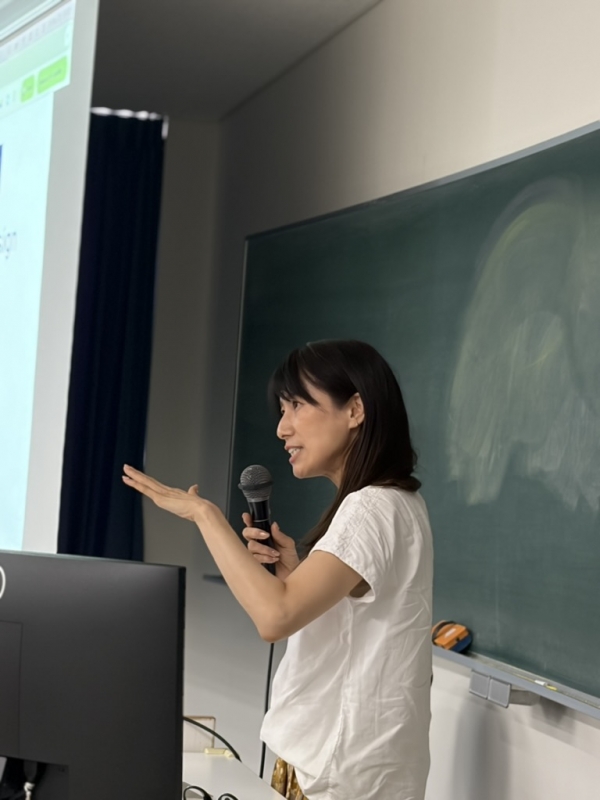 Ms. Hitomi explaining the philosophy behind SISAM and fair trade
-
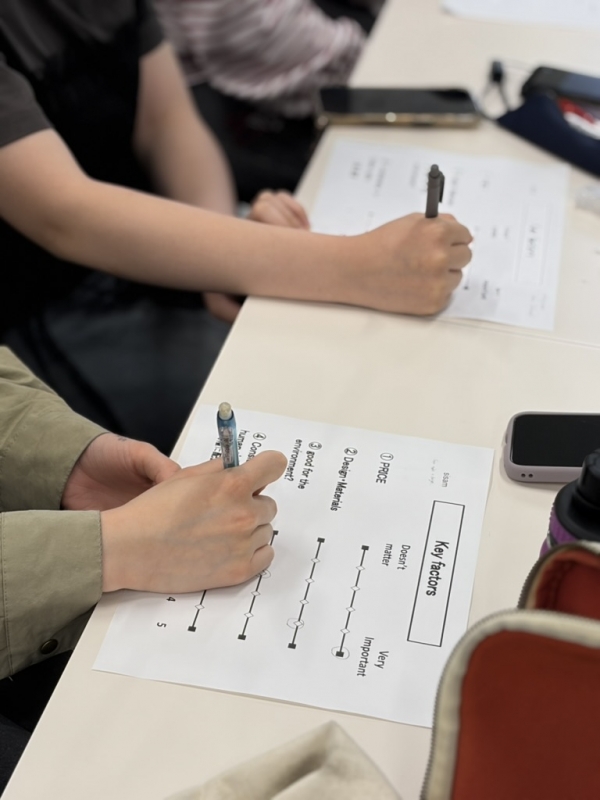 Students reflecting on what they usually prioritize when buying clothes
-
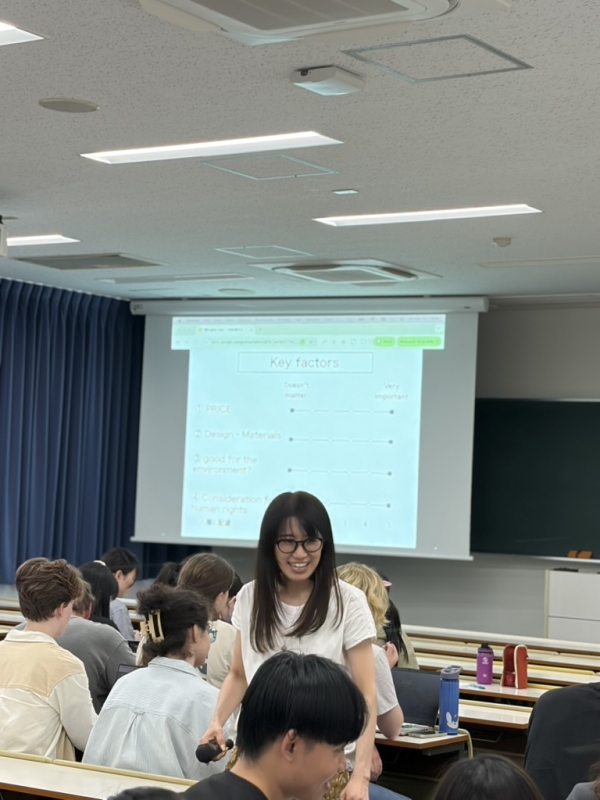 Interactive discussion and exchange of ideas between students and Ms. Hitomi
2026/06/03 19:00:00 Utah State University Visit Strengthens International Exchange at KUFS ユタ州立大学訪問で深まる京都外国語大学の国際交流
- イベント
- Ana Maria Takahashi
From May 18 to May 29, Kyoto University of Foreign Studies (KUFS) welcomed students and faculty members from Utah State University as part of an international exchange and collaborative learning program. During their stay in Kyoto, the visiting students and professors engaged actively with the Department of Global Studies (DGS) and the broader KUFS community through a variety of academic and intercultural activities.
One of the highlights of the visit took place on May 19, when the Utah State University students participated in the DGS Changemaker Guest Speaker Series. The event featured a special lecture by Mr. Thomas Gnocchi, Deputy Head of the Delegation of the European Union to Japan, who spoke about the role of the European Union and contemporary international issues. The session provided students with a valuable opportunity to deepen their understanding of international cooperation, diplomacy, and global challenges from a European perspective.
In addition to attending the guest speaker event, Professor Daniel Holland and Professor David Herrmann from Utah State University organized and conducted a collaborative lecture for DGS students focused on strategic decision-making and management. The session combined theory with hands-on learning and encouraged students to actively engage with one another throughout the class.
A particularly memorable component of the lecture was an interactive trading card simulation activity designed to demonstrate concepts related to negotiation, competition, and strategic thinking. Students worked together in groups, exchanged ideas, and adapted their strategies in real time as the activity progressed. Following the simulation, Professor Holland led a reflective discussion and debriefing session, encouraging students to analyze their decisions and connect their experiences to broader strategic management concepts.
The lecture created a lively and collaborative atmosphere, and the enthusiasm of the participants continued well beyond the classroom session. Approximately 30 DGS students, led by Professor Jane Singer, participated in the activity and contributed actively to the discussions. The event not only strengthened students’ understanding of strategic management concepts but also provided an excellent opportunity for intercultural communication and teamwork between KUFS and Utah State University students.
The Department of Global Studies would like to express its sincere appreciation to the visiting Utah State University students and faculty members for sharing their time, knowledge, and expertise with our students. We would also like to thank the DGS faculty and students whose participation and support helped make the event such a success.
We hope this exchange provided a meaningful and rewarding experience for everyone involved.
-
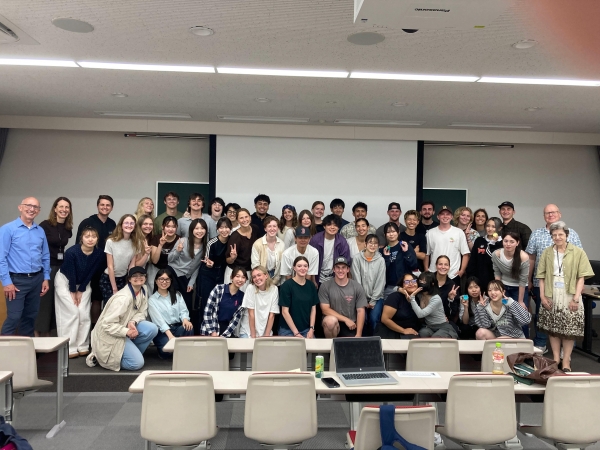 DGS Collaborative Lecture Group Photo
-
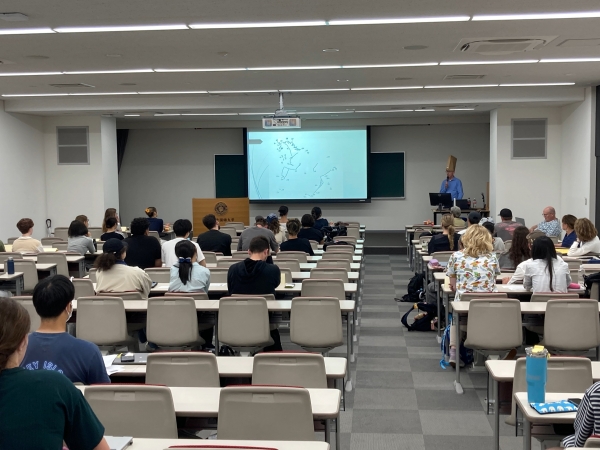 Students divided in groups for the activity
-
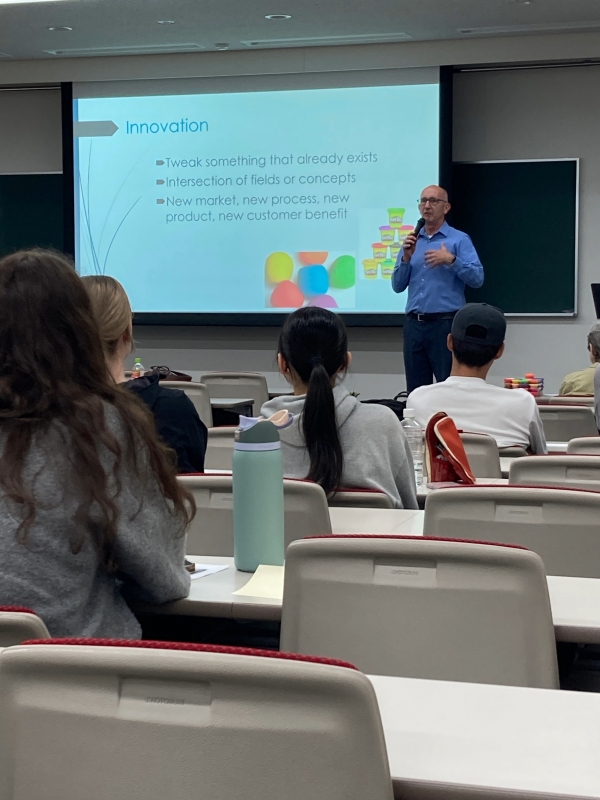 Dan Holland, Ph.D. , Professor of Entrepreneurship and Strategy Huntsman School of Business, Utah State University


