


2026/03/09 14:40:00 Community Engagement in Action in the DGS
 お知らせ
 Kevin Ramsden
Over the past few months, I have been very happy to work with an exceptional 1st year DGS student, Bimal Khatri, who wanted to initiate a truly impactful community engagement project that will benefit a large number of underprivileged children from his home community in Nepal. Bimal is not only a great student, he is also a young man with a big heart and a real vision. Please read more about this wonderful project (below) and if you would like to become involved in some way, simply contact Bimal or myself and we will be happy to let you know how you can make a difference, too.
Our project was started with the goal of supporting children from underprivileged families studying at the Shree Kalika Elementary School in Nepal. Many of these students face financial challenges and lack basic resources that are important for their education. With the support and encouragement from our community, we began Phase 1 of the project to provide essential clothing and shoes to the students.
In Phase 1, we successfully raised funds and purchased 62 track suits and 62 pairs of shoes for the children. These items were delivered and distributed to the students at the school. It was a very meaningful experience to see the children receive the support, and the distribution was carried out with the help of local coordination, the principal of that school to ensure the items reached the intended beneficiaries.
Phase 2 of the project will focus on organizing a fundraising concert to raise additional support for the school. The goal is to help provide important facilities such as classroom benches and desks, improve parts of the school building, and support the construction or improvement of toilets. These improvements will help create a healthier, safer, and more comfortable learning environment for the students.
Phase 3 will focus on organizing food stall fundraising events. Volunteers and supporters can prepare and sell food, snacks, or traditional dishes, and the money raised will be used to support future needs of the school. These events will help generate ongoing support while also bringing people together to contribute to the project in a simple and meaningful way.
The Shree Kalika International Project (SKIP)
by Bimal Khatri
Our project was started with the goal of supporting children from underprivileged families studying at the Shree Kalika Elementary School in Nepal. Many of these students face financial challenges and lack basic resources that are important for their education. With the support and encouragement from our community, we began Phase 1 of the project to provide essential clothing and shoes to the students.
In Phase 1, we successfully raised funds and purchased 62 track suits and 62 pairs of shoes for the children. These items were delivered and distributed to the students at the school. It was a very meaningful experience to see the children receive the support, and the distribution was carried out with the help of local coordination, the principal of that school to ensure the items reached the intended beneficiaries.
Phase 2 of the project will focus on organizing a fundraising concert to raise additional support for the school. The goal is to help provide important facilities such as classroom benches and desks, improve parts of the school building, and support the construction or improvement of toilets. These improvements will help create a healthier, safer, and more comfortable learning environment for the students.
Phase 3 will focus on organizing food stall fundraising events. Volunteers and supporters can prepare and sell food, snacks, or traditional dishes, and the money raised will be used to support future needs of the school. These events will help generate ongoing support while also bringing people together to contribute to the project in a simple and meaningful way.
-
 The Children of Shree Kalika Elementary School
-
 A Student Receiving Essential Clothing and Shoes.
-
 Another Student Receiving Support
2026/03/01 10:50:00 KUFS and Vietnamese researchers co-host workshop on community engagement in Asia Pacific
- イベント
- Prof. Jane Singer
How can universities work with nearby communities to help solve local problems? Engagement with the local community has long been seen as one of the three “missions” of a university, along with education and research. At the Faculty of Global Engagement of Kyoto University of Foreign Studies, all students are required to take two Community Engagement (CE) Workshop courses and spend time embedded in a community doing volunteer activities such as tutoring school children, supporting local festivals, cutting back overgrown bamboo groves and cooking healthy meals for local residents.
For more in-depth understanding of how community engagement plays out in Asia Pacific, a group of Japan- and Vietnam-based researchers, led by Prof. Jane Singer of the Department of Global Studies, has visited eight CE-focused universities throughout the region. On January 28 and 29 a total of 46 students, faculty and non-profit organization staff joined a workshop co-hosted by Kyoto University of Foreign Studies and Danang University of Science and Education in Danang, Vietnam to share their ideas and experience.
On the first day, researchers from both countries explained the history, features and accomplishments of university-led community engagement. As explained by Prof. Singer, community engagement can help to promote a university’s mission, while helping students develop life skills. Its key principles include reciprocity – benefits for all stakeholders – and reflection – students assessing and applying individual meaning to their experiences.
Another workshop presenter, Prof. Angus McGregor of KUFS, explained that in surveys taken before and after students’ community engagement practice, students credited their experience for improving personal skills such as communications, leadership and resilience. According to presenter Dr. Kieu Thi Kinh of Danang University, recent Vietnamese laws and policy promote integrating community engagement into the university curriculum and involving all instructors in CE. She stressed the need for university centers for community engagement to coordinate activities effectively. Other Vietnamese presenters shared their experience in implementing and experiencing service learning activities during intensive summer visits to rural and low-income communities. According to one Vietnamese student, the experience not only helped improve communication and collaboration skills but served to increase empathy and understanding of people from different backgrounds. The first day concluded with student and instructor discussions of steps for improving community engagement outcomes.
On the second day, a smaller group of researchers met with local farmers during a field visit to an organic community garden in nearby Hoi An. The farmers explained how they often hosted ecotourism visits by university students and international tourists wishing to gain a taste of farming and agrarian life. In return, university students and staff have experimented with farm techniques and inputs that have increased farm harvests and raised local income.
-
 Group Photo of Students, Faculy, and Staff
-
 Interview During the Field Trip
-
 A Student Group in Denang
2026/01/26 11:30:00 2026 HULT Prize Competition
- お知らせ
- Aaron Campbell
On January 10, 2026, Kyoto University of Foreign Studies hosted the Hult Prize On-Campus Program. Often called the “Nobel Prize for students,” the Hult Prize is the world’s largest student competition for social entrepreneurship. It challenges teams of university students to create for-profit solutions to real global problems aligned with the UN Sustainable Development Goals (SDGs).
This year, 10 student-led teams (9 from the Department of Global Studies and 1 from the Department of British & American Studies) pitched innovative ideas, and three outstanding teams were selected as winners:
First place: GoGreen
Promoting sustainable living through a community-based recycling and composting app (SDGs 11, 12, 13).
Second place: Pedavolt
Generating clean energy through pedal-powered electricity for off-grid communities
(SDGs 7, 3)
Third place: 4udogs
Using affordable AI smartphone tools to help farmers diagnose crop diseases and increase food production (SDGs 2, 9)
These projects show how KUFS students are turning ideas into action, combining innovation, entrepreneurship, and social responsibility to tackle real-world challenges.
Congratulations to all participants for their creativity, teamwork, and global vision! The future of social innovation and entrepreneurship looks bright at KUFS.
-
 The HULT Prize 2026 Participants
-
 The Winning Team: GoGreen
-
 Participants Present their Ideas in front of the Panel of Judges
2025/12/15 22:20:00 Nagoya International School Visit to DGS
- お知らせ
- Ana Maria Takahashi
On December 5, we were honored to host students and staff from Nagoya International School for a special visit to the Department of Global Studies. It was a wonderful opportunity to share our programs, connect with future global leaders, and showcase the learning environment our students experience every day.
During the visit, NIS guests were introduced to the core learning pathways within our Global Studies curriculum:
• Sustainability & International Cooperation – featuring our Model United Nations activities, presented by Dai, Joyce, and Lewis.
• Global Business & Economics – including insights into the Hult Prize global competition, shared by Manami and Riko.
• Digital Transformation & Change Leadership – introduced by Prof. David Taylor, with Moe and Harry sharing their real-world learning experiences.
NIS guests explored the campus through a Campus Tour & Quiz Rally, discovering key campus locations and learning more about student life at DGS.
A heartfelt thank you to everyone who contributed. Your support made this visit meaningful and memorable.
And a warm thank you to all our visitors from Nagoya International School. We truly enjoyed welcoming you to our campus and hope today’s experience inspires your future global journeys.
-
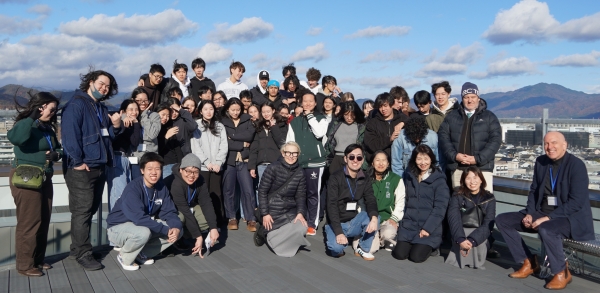 Students from KUFS and Nagoya International School on the top of Building 4
-
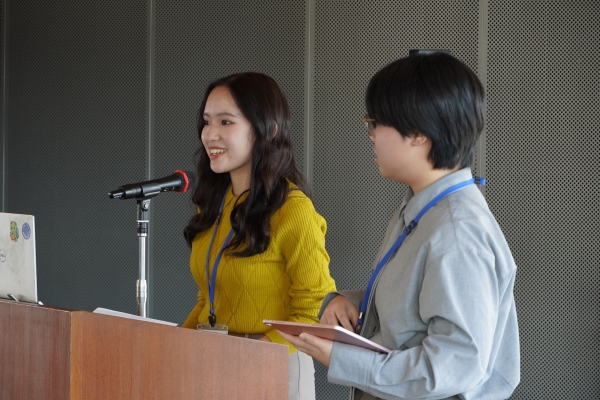 DGS students making a speech to NIS students
-
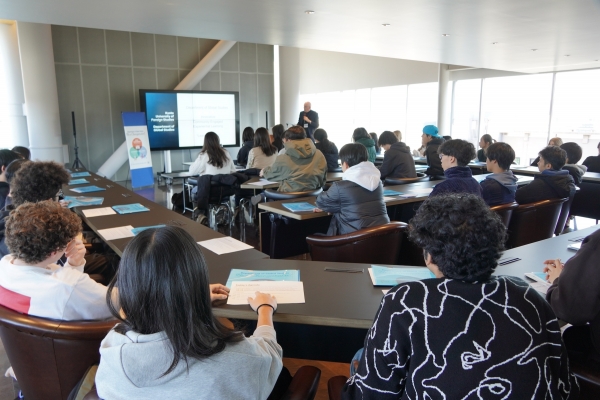 Chair David Taylor presenting
2025/11/18 09:40:00 DGS Profesor Junko Kondo Presents Her Research in Michigan, USA.
- お知らせ
- Aaron Campbell
On November 14th, 2025, Professor Junko Kondo delivered a presentation titled “Embracing Indeterminism as an Enabler of Transformative Education among Place-Based Educators” at the Place-Based Education Conference held at Eastern Michigan University, USA.
This conference brings together researchers and educators from across the United States who are committed to stepping outside the traditional classroom, engaging with local communities, and practicing inquiry-based, experiential education. Its philosophy and practice strongly resonate with KUFS’s Community Engagement program.
In her presentation, Professor Kondo highlighted the cultural benefits of community engagement, emphasizing how such practices embody a critique of modern societal norms. She discussed the value of learning alongside communities in an era marked by intertwined ecological and social crises. Her insights were met with strong resonance and appreciation from the researchers and practitioners in attendance.
The perspectives shared at this conference will undoubtedly contribute to the ongoing development of Community Engagement and sustainability-focused education within the GS program at KUFS.
The content of this presentation is based on an article published in September 2025 in the Australian Journal of Environmental Education (Cambridge University Press):
Australian Journal of Environmental Education, Volume 41, Issue 4, September 2025, pp. 843–856. https://doi.org/10.1017/aee.2025.10059
-
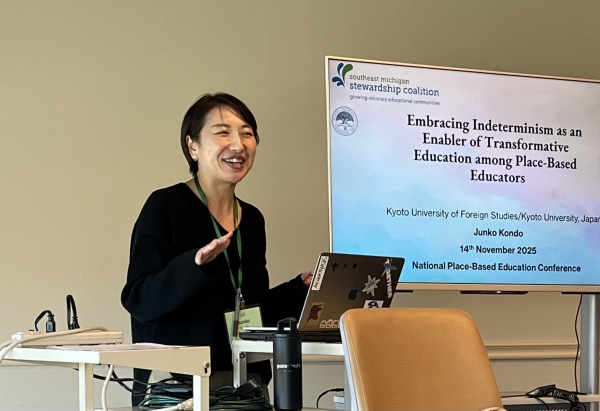 DGS Professor Junko Kondo
-
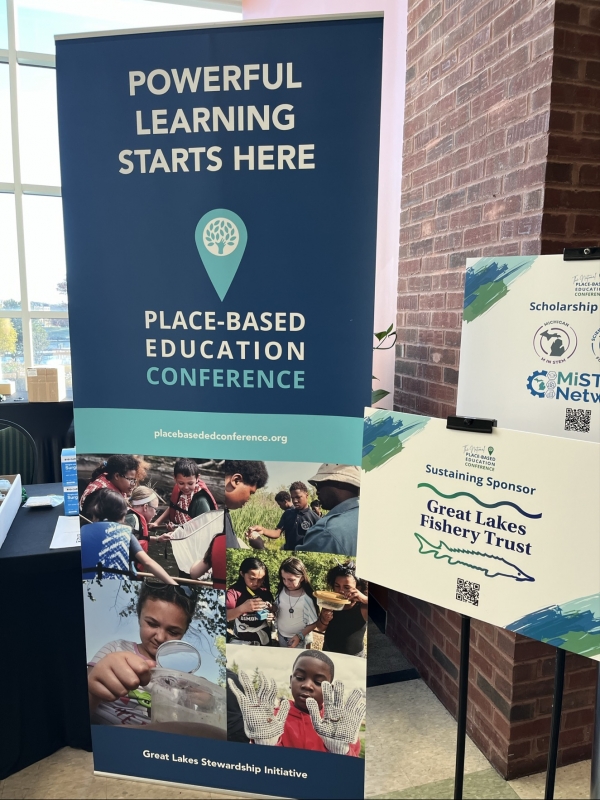 PBE Conference Sign at Eastern Michigan University
-
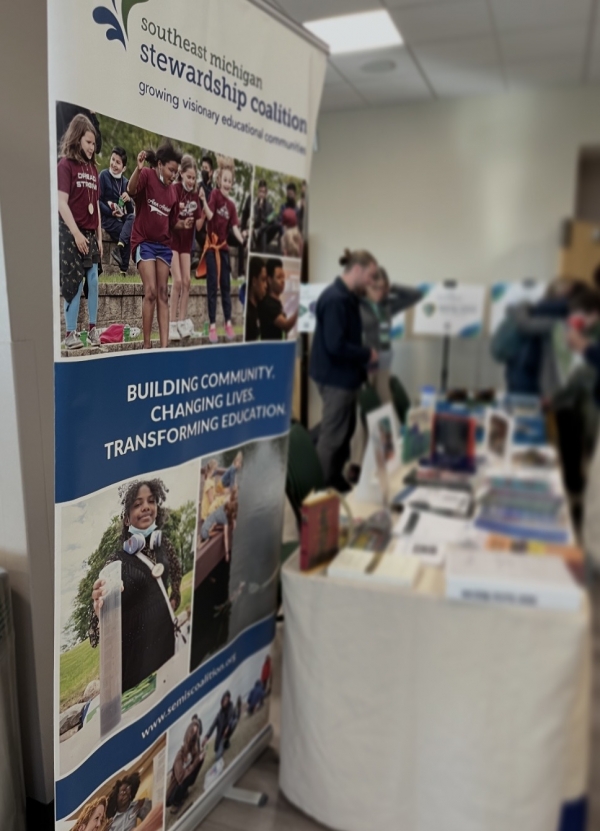 One of the Conference Booths


