


2026/05/28 13:20:00 Professor Gustavo Tanaka Publishes Modern Business Case Studies 現代ビジネスのケーススタディ
 お知らせ
 Amelia Ijiri
7-Eleven Japan: The Human Side of the Konbini Empire
7-Eleven’s success is often attributed to its advanced logistics systems, data-driven inventory management, and highly efficient franchise model. However, behind these systems lies a less visible but equally critical driver: Human Resource Development (HRD). This case focuses on how the company’s HRD across franchisees and frontline employees enables consistent performance at scale, particularly as the workforce becomes more diverse. It invites students to analyze the situation and propose ideas and recommendations at decision-making points throughout the case study.
Nikkei BizRuptors - 7-Eleven Japan: The Human Side of the Konbini Empire
Dr. Gustavo TANAKA | Faculty of Global Engagement, Kyoto University of Foreign Studies
Dr. Keith JACKSON | Kobe University
Kim Thanh LE | Nikkei BizRuptors
Fundamental Principles of Financial Accounting - A Case Analysis of a Bakery Startup
This case study delves into the strategic and financial evolution of “Tony’s Cakes” as it transitions from a home-based startup to a formalized SME in 2025. By examining the operational shifts from solo baking to managing a professional payroll and industrial equipment, this analysis aims to illustrate the complexities of the financial accounting and reporting of a manufacturing company. The narrative focuses on the practical application of accounting principles, such as calculating the Cost of Goods Manufactured (COGM), managing industrial equipment investments, and understanding SME tax regulations.
Nikkei BizRuptors - Fundamental Principles of Financial Accounting - A Case Analysis of a Bakery Startup
Prof. Gustavo TANAKA | Faculty of Global Engagement, Kyoto University of Foreign Studies
Arnecht KANCHANATAVEE | Transmax Co., Ltd.
Mishell ALBORES | Nikkei BizRuptors


2026/05/21 08:10:00 The EU in the World and EU–Japan Relations |世界の中のEUと日EU関係 ― 京都外国語大学DGS Changemaker Guest Speaker Series
- イベント
- Ana Maria Takahashi
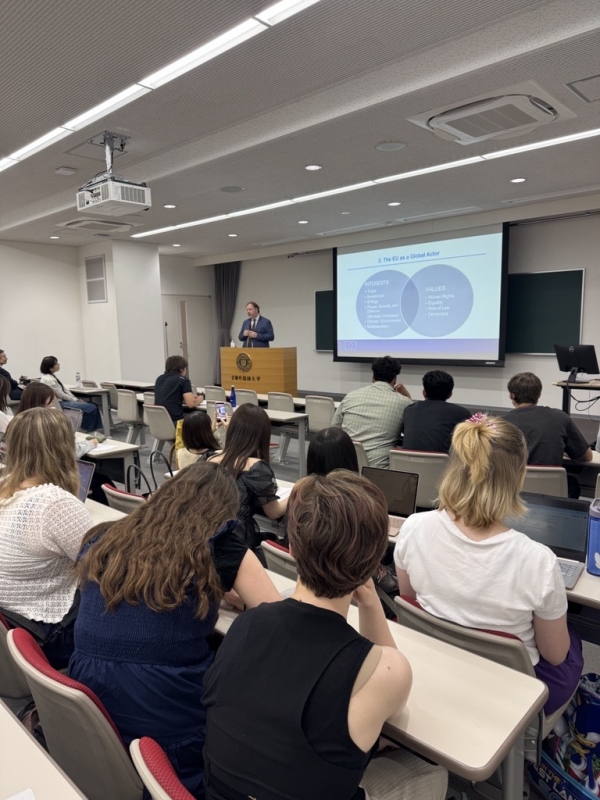
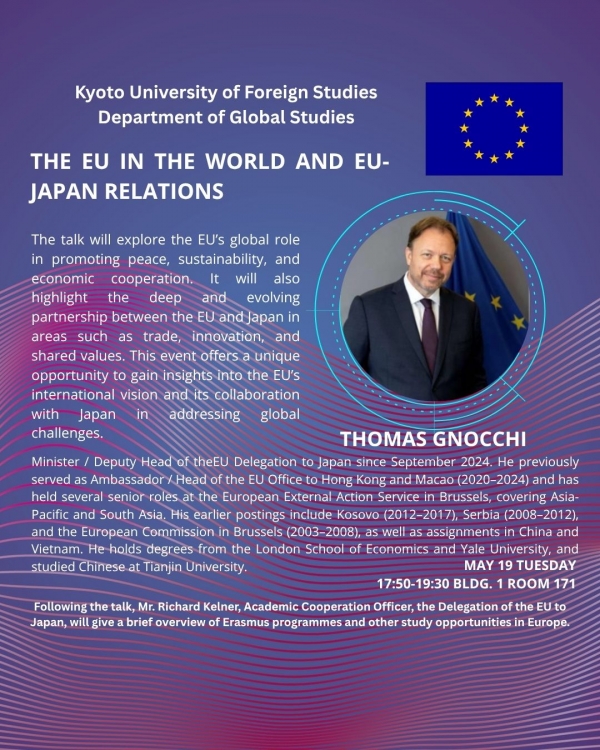
On May 19, 2026, the Department of Global Studies at Kyoto University of Foreign Studies welcomed Mr. Thomas Gnocchi, Deputy Head of Delegation at the Delegation of the European Union to Japan, for a lecture titled “The EU in the World and EU–Japan Relations.”
During the lecture, Mr. Gnocchi provided a comprehensive overview of the European Union, explaining its historical origins, core values, and evolving role as a global actor. He discussed how the EU was created from the lessons learned after World War II, emphasizing peace, stability, democracy, human rights, and cooperation among member states.
The lecture also explored the EU’s growing international role in areas such as trade, security, climate policy, humanitarian assistance, and diplomacy.
Particular attention was given to the EU’s relationship with Japan. Mr. Gnocchi highlighted the importance of the Strategic Partnership Agreement (SPA), the Economic Partnership Agreement (EPA), and recent developments in digital, environmental, and security cooperation between the EU and Japan. He also discussed future areas of cooperation, including research and development, clean industries, semiconductors, economic security, and defense collaboration.
The presentation also addressed current international challenges, including the EU’s continued support for Ukraine and support for Ukraine’s path toward EU accession.
The Q&A session that followed generated lively discussion among students. Questions focused on the current situation of the EU and the challenges of managing such a large and diverse organization. Students were particularly interested in how efficiently the EU operates and how new countries can join the Union, including the timeline and accession process.
Other questions explored how the EU balances increasing geopolitical tensions. Students also asked about immigration issues and Europe’s ageing society, leading to discussion about possible lessons Japan could learn from European experiences and policies.
The lecture offered students an important opportunity to deepen their understanding of the European Union’s global role and the growing significance of EU–Japan cooperation in an increasingly interconnected world.
The Department of Global Studies would like to sincerely thank Mr. Thomas Gnocchi for his insightful lecture and engaging discussion with students.
The Department of Global Studies would also like to thank Mr. Richard Kelner, Academic Cooperation Officer at the Delegation of the European Union to Japan, for delivering a short presentation at the end of the event highlighting Study in Europe opportunities, Erasmus+ programmes, and the upcoming European Higher Education Fair.
2026/05/11 14:50:00 Community Engagement Workshop Welcomed Mr. Chuck Kayser from Midori Farm オーガニック農家・教育者 チャック・ケイサー氏による特別講義
- イベント
- Junko Kondo
On May 8th, Community Engagement Workshop A welcomed Chuck Kayser as a guest speaker. Chuck shared his journey as an organic farmer, educator, and community member who has dedicated many years to creating a more sustainable relationship between people, food, and the environment.
Chuck explained that he began gardening about 15 years ago in the mountains of Shiga Prefecture without much prior knowledge of farming. What started as a small personal interest gradually developed into a deep passion for growing food and living close to nature. Over time, he founded Midori Farm and has continued to welcome visitors, volunteers, and students from around the world to learn about organic farming and sustainable living.
During the lecture, Chuck spoke honestly about both the rewards and difficulties of organic farming. He explained that farming is not an idealized lifestyle, but rather a continuous process of learning, adapting, and struggling together with nature. One memorable topic was the challenge of wild animals damaging crops. In response to a student question about how he deals with attacks from monkeys and other animals, Chuck shared candidly that he still struggles with monkeys stealing food from the farm. However, instead of giving up, he sees these experiences as part of living within a larger ecosystem and continues to pursue his path as an organic farmer.
Students also asked practical questions such as how university students can live more sustainably and which vegetables are easy or difficult to grow. Chuck encouraged students to begin with small and realistic actions in their daily lives, such as paying attention to where food comes from, supporting local or organic producers when possible, reducing unnecessary consumption, and reconnecting with nature through direct experiences. Regarding farming, he explained that some vegetables are relatively easy to grow, while others require more knowledge, patience, and protection from weather and animals, but that the process itself teaches valuable lessons about life and interdependence.
Chuck also introduced his farms in Keihoku and Shiga and shared how he sells his vegetables at Woody Keihoku, the local Michi no Eki roadside station. It was interesting for students to learn about the local systems and relationships that support small-scale organic farming, and Chuck warmly invited students to visit his fields in the future. Another particularly inspiring part of his talk was his project of inviting artists to stay and create artworks at the farm. Students were inspired to learn that not only farming itself, but also art and creative expression, can become part of a broader movement toward sustainability and community building.
A particularly inspiring part of the lecture was Chuck’s reflection on why he chose organic farming despite its difficulties. He described organic farming not simply as an occupation, but as an attitude and ethical choice. Rather than pursuing the most profitable industry, he chose what he believes is a healthier and more wholesome way of living on the Earth. He also connected farming to broader economic systems, emphasizing the importance of choosing actions that support sustainability and ecological responsibility.
Throughout the session, students were able to hear not only technical knowledge about farming, but also deeper reflections on lifestyle, values, community, and humanity’s relationship with the natural world. Chuck’s honest and thoughtful stories encouraged students to reflect on their own ways of living and the meaning of sustainability in everyday life.
We sincerely thank Chuck Kayser for sharing his experiences and insights with our students.
-
 Mr. Chuck Kayser answering students’ questions about organic farming and sustainable living
-
 Community Engagement Welcomes Midori Farms
2026/04/29 14:20:00 Embracing Your Roots & Routes: Design Your Unique Perspective to Change Society自分らしいキャリアの描き方
- イベント
- Ana Maria Takahashi
Embracing Roots and Routes: A Powerful Talk by Miho Kitagawa Pedroso
The Department of Global Studies was pleased to welcome Miho Kitagawa Pedroso, Founder and Director of immi lab, for an inspiring lecture on April 28, 2026.
Titled “Embracing Your Roots & Routes: Design Your Unique Perspective to Change Society,” the talk invited students to reflect deeply on their experiences and future paths. Drawing from her own journey across disciplines—from chemistry and engineering to design research and ethnography—Miho encouraged students to embrace uncertainty and see value in diverse experiences. Her message was clear: our personal histories (“roots”) and the paths we choose (“routes”) can become powerful tools for meaningful social impact.
Beyond her personal story, the lecture shed light on an important issue: the experiences of youth with immigrant backgrounds. Many of these young people, despite being born and raised in Japan, feel social isolation and challenges in shaping their identities.
Through the work of immi lab, Miho and her team are actively addressing this gap. Initiatives such as Projeto Ponte create spaces for dialogue between immigrant youth and Japanese society, fostering mutual understanding and empowering young people to build resilience and envision their futures.
The lecture was very important for our students, not only helping raising their awareness of structural social challenges but also encouraging them to think critically about their own roles in society.
We extend our gratitude to Miho for her inspiring talk.
https://www.immilab.org
#Kufs,#GlobalStudies, #GuestLecture, #Changemakers
-
 Miho Kitagawa Pedroso talks with GS Students
-
 Reflecting on uniqueness
-
 A lively Q & A about immigration issues in Japan
2026/04/27 12:20:00 Accounting for the Ordinary People - A Case Analysis of a Taxi Service Startup
- お知らせ
- Aaron Campbell
We’re pleased to introduce another compelling case study by Professor Gustavo Tanaka of the Department of Global Studies, Kyoto University of Foreign Studies, in collaboration with Arnecht Kanchanatavee (Transmax Co., Ltd.) and Mishell Albores (Nikkei BizRuptors).
Read the full article on Nikkei BizRuptors.
This case takes a storytelling approach to explore accounting in the real world, following the journey of Lisa, a young professional in Thailand who leaves behind a stable office job to pursue an independent taxi business in the growing gig economy.
As Lisa builds her business, the study traces her development from simple cash tracking to a more structured operation. Eventually, she forms a partnership with her brother, Phuwin, which introduces new financial complexities, including the need for professional accounting practices across both gasoline and electric vehicle operations.
The case highlights key accounting concepts in a highly practical context, such as the Economic Entity Assumption, Accrual Basis, and the Matching Principle. It also addresses real-world challenges faced by startups, including the decision between capitalizing or expensing costs, and managing corporate income tax obligations as the business expands.
By grounding technical accounting principles in an engaging human story, this case makes financial concepts more accessible and relevant, particularly for students interested in entrepreneurship, the gig economy, and business development in Asia.
Business, economics, accounting, and entrepreneurship are a core part of the curriculum in the Department of Global Studies. Visit our department home page to learn more.


