


2025/06/09 22:50:00 Writing with Empathy (WWE)
 教授の声
 Kevin Ramsden
Unless you are very academically minded, or extremely interested in a particular subject or topic, it can sometimes be very difficult to get to grips with writing for academic purposes when you first start, either in school or at college. Perhaps it is just the process that you find difficult and are put off by the rules that are often applied to this style of discourse. There is also the question of the research that is required to make sure your essay or paper is factually solid and correct. Sure, there is a wealth of information and sources on the internet you can plunder, but now there is also the minefield of what to include from your findings in terms of AI generated content and having to be aware of plagiarism. Actually, I like to balance my own academic writing output with some examples of creative writing. In this way, I can enjoy writing about a topic or theme from another perspective, and even come to learn and understand it better. This is what is known as Writing with Empathy (WWE).
So, what do I mean by writing with empathy? Well, basically it is a more creative approach to writing on a topic or theme, which means producing a piece of writing that is mostly fictional rather than completely factual. For example, if you are studying about the lives of refugee children from a war-torn region, you can do a lot of background reading on their problems through online articles and accounts first, and then consider what you have read and try and put yourself in their shoes (empathy) and write a story based on those experiences.
These days many people are experimenting with “flash fiction”, which is a piece of writing between 300 and 1,000 words only. Believe me, it is surprising how much you can include in such a short word count, and very good practice for getting your point across succinctly and with great precision. Of course, there are also many topics or themes on personal and societal issues for the eager writer to get their teeth into, such as educational issues, environmental issues, gender issues, poverty and homelessness, loneliness, etc. Here is an example short story from my own work, which focuses on how teachers sometimes struggle with motivating their students: Monkey Want Banana.
And here is another. A piece of flash fiction that illustrates how parents have to cope with an “empty nest” when their children leave home. It is all about loss and loneliness really. I’m sure many parents have to deal with this at some point: Counting the days til summer.
There are also some great opportunities to explore WWE further and even win some prizes for your work (sometimes with money!). There are a number of theme-based creative writing competitions run by international organizations and universities annually, and this is a terrific way to build on your writing skills and get your work out into the world.
https://www.greenstories.org.uk/
https://blog.reedsy.com/writing-contests/short-story/
Of course, I am not saying that creative writing should replace academic writing in the university, but rather it can be an enjoyable way to supplement understanding of the topics or themes you study about and even inspire and encourage others to do the same.
Happy writing!
Kevin
-
 Empathy is important.
-
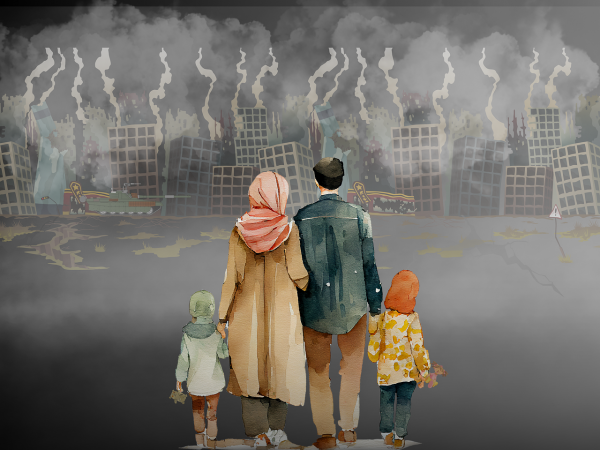 Some families live in war zones.
-
 Here Comes Kenji Book Cover.
2025/05/30 12:40:00 Lessons in Confidence and Courage from Guest Lecturer Mr. Ryucrew: Global Engagement Course – May 21st
- イベント
- Junko Kondo
On May 21st, our Global Engagement class for first-year students welcomed a truly inspiring guest: Mr. Ryucrew, an international flight attendant, YouTuber with over 310,000 subscribers, and published author. What he delivered was far more than a career talk. Through a candid, humorous, and deeply personal story, he invited us to reflect on identity, courage, and embracing imperfection.
From growing up in Osaka to working for a North American airline, Mr. Ryucrew shared the challenges of learning English, navigating cultural differences in Canada. One powerful message he emphasized was:
“Accent doesn’t matter if you can communicate.”
These words resonated deeply with many students who had experienced language anxiety and cultural adjustment themselves.
Mr. Ryucrew also spoke about resilience and reinvention. During the pandemic, when flights stopped, he didn’t just stay as he was. Instead, he launched his YouTube channel.
Students found his creativity and openness equally inspiring. “Mr. Ryucrew’s speech really stood out to me because of his honesty and resilience. His openness to failure was refreshing, and his message about overcoming self-doubt was encouraging. The most lingering thing for me was the way he saw creativity as a way of thinking, not just a skill, but a tool for problem solving and connecting. It made me reflect on how I face challenges in my life”.
A common theme echoed through student reflections: Confidence doesn’t come from perfection—it comes from embracing who we are.
As one student beautifully summarized as a message to him: “Your journey reminded me that it’s okay to fail, as long as we keep moving forward. Your words sparked something in me to stay creative, stay bold, and trust the process. Keep inspiring.”
To Mr. Ryucrew: thank you for your radiant energy, your honesty, and for reminding us that the sky (and YouTube) are the limit when we live with courage.
His YouTube video recording of this class is now available here: https://youtu.be/p20QWa00Qbc?si=aJjiwqKVJ4hTBgXJ
-
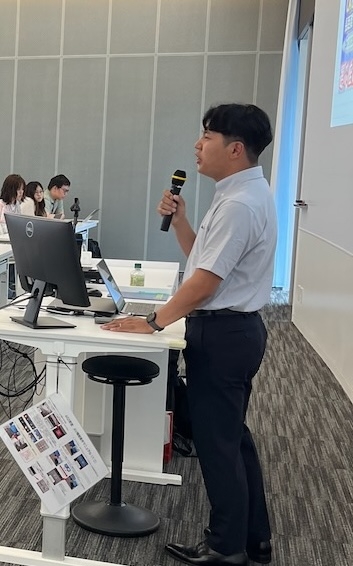 Mr. Ryucrew Speaks with GS Students
-
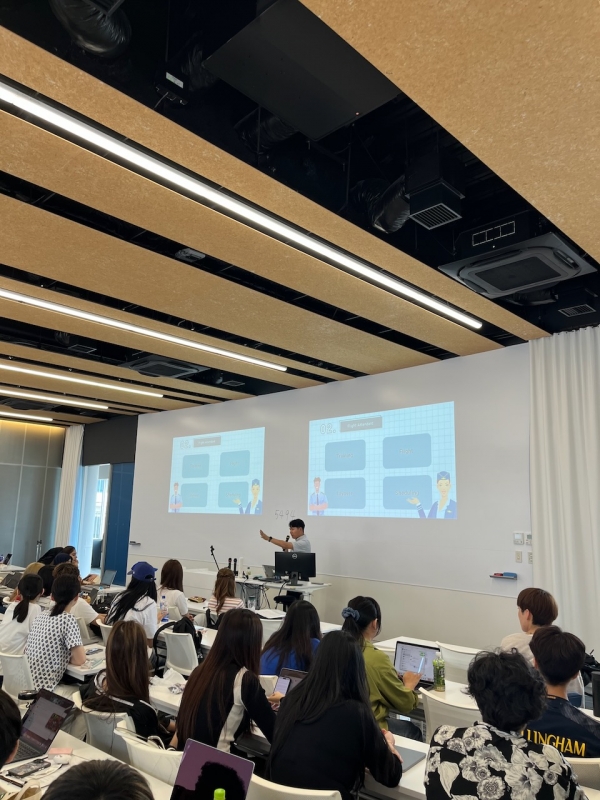 GS Students listen attentively to Mr. Ryucrew's talk
2025/05/24 17:30:00 Brian Collins - A Lecture From a Former Disney Imagineer
- イベント
- Aaron Campbell
On May 12th, 2025 the Faculty of Global Engagement welcomed Brian Collins to Morita Hall, where he delivered a lecture entitled "Creating the Magic for Disney" to an audience of approximately 150 students from all departments throughout the university.
In addition to his long career with Disney, Collins is also an instructor at the Rosen College of Hospitality Management at the University of Central Florida in Orlando, one of the world's most prestigious schools in tourism and hospitality.
In his talk to KUFS students, Collins shared his experience as an Imagineer, helping to create magical experiences for visitors to Disney theme parks. He showed the important role that storytelling and creativity, along with innovation, plays in creating the magic that so many people have come to love.
One important question he posed to the audience was, "Are you crazy enough to change the world?" This theme ran through his message, and he encouraged our students to be unique, push boundaries, and to think and act in different ways than others.
Collins also addressed technology - especially advanced technologies like A.I. and robotics - can be used to enhance human interaction and story-based connection. The future of hospitality seems bright and limitless.
Finally, Collins ended his talk with some group photos and a question and answer session with interested students.
The promotion of this event was made possible by the hard work of two Global Studies students, Nodoka Okada and Akemi Nakashima, in collaboration with two students from the Global Tourism department, Mako Iwamoto and Nodoka Kawahara. All four students designed the posters and social media posts that promoted the event in advance and afterwards. It was a job well done!
-
 Former Disney Imagineer Brian Collins
-
 Brian Collins on Stage at Morita Hall
-
 Brian Collins Takes a Selfie with KUFS Students
2025/05/23 12:20:00 Visit from Utah State University Students
- お知らせ
- Ana Maria Takahashi
Twenty-three Utah State University students and two teachers visited KUFS from May 8 to May 21. During their visit, they interacted with the DGS students and the KUFS community by participating in guest speaker events on campus and leading a collaborative lecture with DGS students.
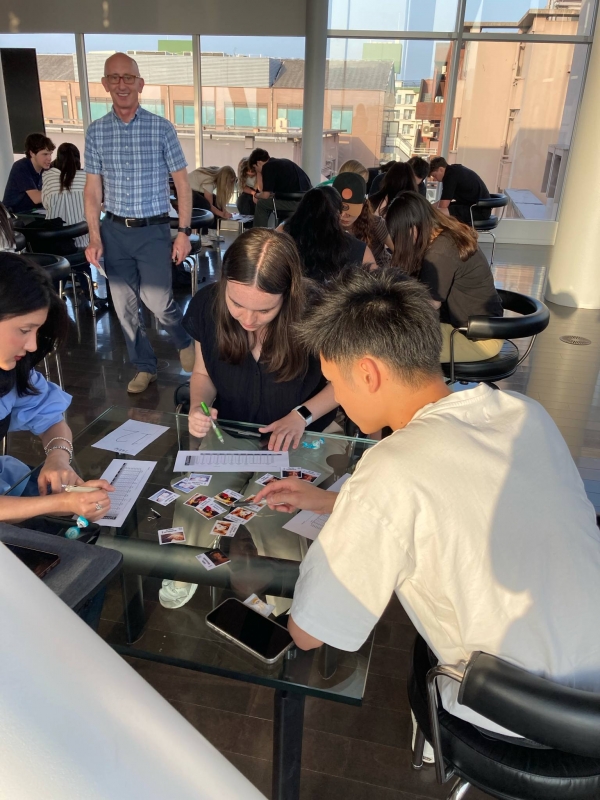
On May 20, the 23 students and their professors, Professor Daniel Holland and Professor David Herrmann, led a collaborative lecture on strategic decision-making. The session included an energetic trading card activity designed to encourage student interaction. At the end of the lecture, Professor Holland facilitated a debrief and a discussion.
The trading card activity focused on either building a collection or aiming for high-value cards. It was a thoughtfully designed exercise intended to teach students about various strategic business approaches to maximize outcomes. Student teams could merge, seek out valuable information to improve outcomes, or make calculated trades based on other teams’ analysis.
The interactive and engaging nature of the activity helped students better understand key strategic management concepts. The lecture was very well received and thoroughly enjoyed by the DGS students. Around 30 third- and fourth-year DGS students participated in the lecture and activity. The excitement among the DGS students was palpable and led to extended discussions and contact exchanges after the lecture.
We would like to sincerely thank the Utah State students and their professors for organizing this engaging session. We also extend our appreciation to the DGS students for their enthusiastic participation. We hope it was a mutually beneficial experience.
-
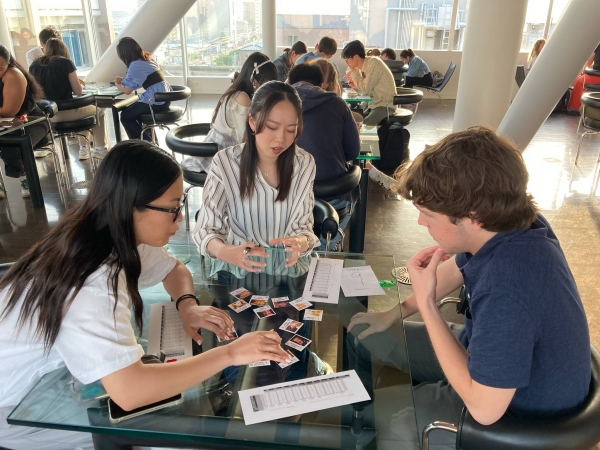 GS students and a student from Utah State doing a trading card activity
-
 A Utah State professor oversees a student exchange activity
-
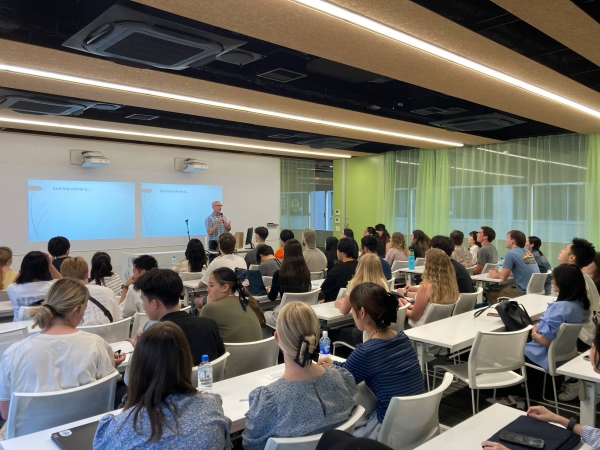 Students listen to a lecture by Utah State professors
2025/05/20 07:30:00 Reimagining Service as a Bridge to Learning: Lessons from Prof. Kuronuma’s Guest Lecture
- イベント
- Junko Kondo
Introduction to Service-Learning: Learning through Engagement with Communities
On May 9th, 2025, the Community Engagement Workshop A class (for second-year students) welcomed Professor Atsuko Kuronuma from International Christian University for a guest lecture on Service-Learning. This course serves as preparation for students’ community engagement projects planned for the fall.
Professor Kuronuma introduced three key concepts - service, reflection, and reciprocity - that invited students to rethink the meaning of meaningful community engagement. She also provided a useful framework for mapping community engagement within the broader field of service-learning.
We were also joined by visiting students from Utah State University, who actively participated and brought diverse perspectives to the discussion. We deeply appreciated their involvement.
Professor Kuronuma’s lecture was rich in interactive activities and beautifully embodied the philosophy of service learning. One group activity asked students to rank various actions, such as disaster relief or military service, in terms of their value as “service.” This sparked thoughtful conversations and highlighted both cultural and individual differences in perception. While some students saw military service as highly valuable due to its physical and emotional demands, others hesitated, pointing out the complexity of its role in society.
Through this experience, many students came to understand service not merely as an act of helping others, but as a reciprocal relationship in which both sides learn and grow. Reflection, too, was reframed - not just as writing in a journal, but as a process of personal and social transformation. The “What? → So what? → Now what?” model of reflection particularly resonated with students.
The lecture also helped students clarify the differences between volunteering, internships, and service-learning. What sets service-learning apart, they learned, is its academic foundation and its focus on mutual benefit. One student reflected, “It’s not about what you’re doing, but why and how.”
Professor Kuronuma emphasized the importance of the hyphen in service-learning, describing it as the bridge between action and learning. That bridge, she explained, is built through students’ reflective engagement with their service experiences.
This lecture left a strong impression on the class and provided valuable tools and insights for their future community-based activities. We are deeply grateful to Professor Kuronuma for her inspiring and thought-provoking session.
-
 Professor Kuronuma speaking to GS students


