


2021/09/22 12:10:00 Prof. Takeuchi New Publication
 お知らせ
 Department of Global Studies
We are pleased to announce the new publication "Understanding United Nations Security Council ("UNSC") Reform; a Novel Approach from the Perspectives of Legitimacy, Efficacy, and Representativeness," co-edited by Prof. TAKEUCHI Toshitaka of Kyoto University of Foreign Studies ("KUFS"), Global Studies Department and Dr. and Ambassador Takahiro Shinyo of Kwansei Gakuin University. Prof. Takeuchi teaches Community Engagement, Conflict Resolution, Peace Design, Security Studies as well as Japan-US and East Asia Relations in the Department of Global Studies at KUFS. His research interests include international relations, arms control and disarmament, nuclear weapons and game theory.
The book examines the rise of nationalism as well as the path toward UNSC reform. More information is available on the publisher's website.
https://www.toshindo-pub.com/book/91718/
-
 "Understanding United Nations Security Council ("UNSC") Reform"
2021/08/03 11:40:00 Model United Nations
- イベント
- Prof. Takaaki Miyaguchi
MUN July 17, 2021
We are very happy to report that our fourth Global Studies Model United Nations and its General Assembly event were successfully held at Morita Hall on July 17th, 2021 with over 120 first year Global Studies students deliberating on the agenda of COVID-19, including the three subtopics related to the United Nations Sustainable Development Goals: Decent Work and Economic Growth; Quality Education; and Ending Poverty & Hunger.
Kyoto University of Foreign Studies, together with other partner institutions, has a long tradition of teaching and organizing various events related to the United Nations, reflecting our motto of Pax Per Linguas, World Peace through Languages. As previously written about in this blog, one such event, JUEMUN (Japanese University English Model United Nations) is an annual Model UN event held for three days in June, that both KUFS students and faculty not only participate in, but also act as co-organizers.
Building upon this tradition and experience, when the Department of Global Studies was officially launched in 2018, the department's own Model United Nations course was determined as a required course for all first-year students. Model United Nations is a simulation of United Nations meetings, in which participating students represent one of the 193 UN member states, or countries, and work together, giving speeches, debating, negotiating, and ultimately writing resolutions for certain issues before the United Nations. Through simulating the roles of diplomats and as representatives of UN member states, student delegates are expected to be able to learn how to research various global and domestic issues, and how to formally strategize and come up with effective policies in order to improve the situations not only at the domestic level, but also at the global level.
The Global Studies Model United Nations course is offered to all GS freshman in the spring semester and is immediately challenging and difficult as students are introduced to both the work and challenges of the United Nations, an international organization working to bring all 193 members states together to share their concerns and, above all, their hopes and ideas for moving the world towards a better and more peaceful future. Students also are made aware of not only the progress that is being made towards those goals, but also the limits that international organizations, such as the United Nations, have.
The students were assigned a country team, consisting of 8-9 students, which represented one of the selected 15-member states, and tasked with working together to think, communicate, and behave as diplomats representing their countries. Through this course, the students, with mixed levels of motivations and sometimes confusion, learned the difficulty in identifying their country’s priorities and above all, in identifying common denominators that challenge the global community to ultimately agree upon.
In order to successfully complete this course, the students were required to think critically, demonstrate leadership, access and analyze information effectively, and to master both written and verbal effective communication skills, all while studying about their assigned country, the agenda topic related to COVID-19, and possible solutions to curb the impact of this pandemic on issues related to economic growth, the spread of poverty, and the loss of quality education.
The course requires students to put their minds together not only to share the situations within their assigned countries, but also through negotiations and therefore compromises, to set ambitious international goals for the international community to agree upon in how to effectively lessen the impact of COVID-19. The final documents, or UN resolutions, that were generated and agreed-upon through the final General Assembly event, are the direct results of sharing the concerns, values and above all, the hopes of all the UN member states.
As new students on campus, and also faced with taking most classes online, it is easy to imagine the maze of confusion they faced when dealing with such difficult issues in their spring semester. However, looking at the pictures from the General Assembly event at Morita Hall, students readily took on the challenge and actively engaged with each other to not only meet their instructors’ expectations, but wildly exceed them.
To those students who participated in this year’s Global Studies Model United Nations: Congratulations on successfully completing this challenging course. Job well done!
-
 MUN General Assembly at Morita Hall
-

-
 Profs. Miyaguchi and McGregor
2021/07/19 12:30:00 UKYO X KUFS 90th Project
- お知らせ
- Prof. Kevin Ramsden
UKYO X KUFS 90th Project
A project to help Ukyo Ward celebrate its 90th anniversary is currently underway in the Community Engagement Center of our university. This is an academia-government-community-industry collaboration involving a university (KUFS), a local government (Ukyo Ward), a local community (Ukyo-ku residents), and a company (Mirai Translate Inc.). Six students from the Department of Global Studies are actively participating (Nik, Yuria, Ruka, Ayane, Ryo and Eri), along with four students from the Department of British and American Studies two students from the Department of Global Tourism, and three students from Kyoto Gaidai Nishi High School.
In this project, students go out in pairs and interview representatives of six organizations in Ukyo-ku for ‘Ukyo in Action’ and six active Ukyo-ku residents for ‘Living Histories’ and then write up their research and interviews in articles, in both Japanese and English. The project goal is to create a bilingual website based on these interviews and launch it in early October.
Currently, all of the Ukyo in Action interviews have now been completed with leaders and officials at Ninnaji Temple, Kyoto Hannaryz (a professional basketball team), Kyoto Minsai Japanese Language School, Kameya Hirokyo (a long-established Japanese and Western style confectionery shop in Keihoku Town), Sushiyone (an inn in Keihoku Town), Sukoyaka Sagano Urban Farm, and the Japan Cat Network (an animal rescue NPO).
One of the other challenges of this project is for the students to make use of machine translation. While translation tools, such as Google Translation (USA) and DeepL (Germany) are already widely used, Japan also has an excellent machine translation tool called Mirai Translator. In this project, Japanese-English translations will be conducted with the support of Mirai Translate Inc., the developer of the Mirai Translator. A few weeks ago, the company kindly provided a seminar/workshop on machine translation for us, and in this workshop, we learned that when using machine translation, adding manual work such as pre-editing and post-editing is the key to producing high-quality translations.
Please go to the project's Instagram to see how the members are getting on. The website will be completed at the beginning of October, and this will be announced on the project's Instagram, the Global Studies Department Blog, posters, etc. We really hope you are looking forward to it!
https://instagram.com/ukyoxkufs_project?utm_medium=copy_link
-
 UKYO x KUFS logo and Instagram
-
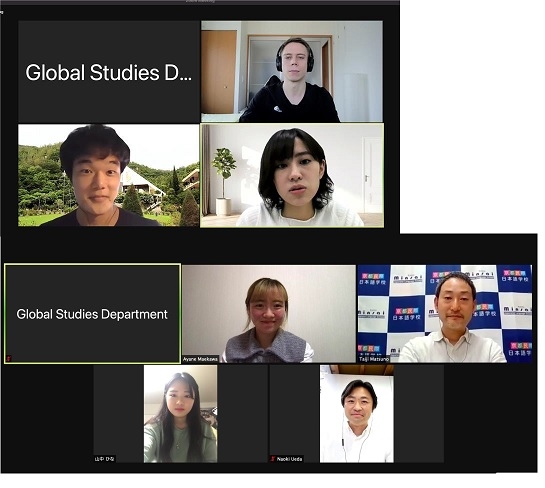 Kyoto Hannaryz and Minsai JLS interviews
-
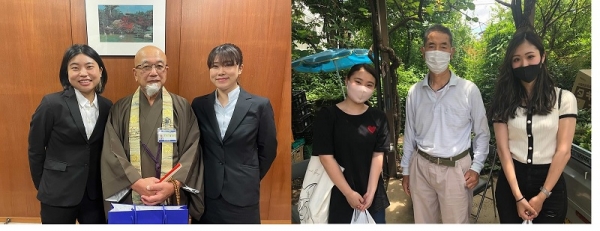 Nnna-ji and Sagano Farm Interviews
2021/07/02 14:20:00 DGS Student Leadership Reflections and Changemaker Lessons Learned: Nik Weigelt
- イベント
- Niklaus Weigelt, fourth-year student at the Department of Global Studies
The 12th annual Japan University English Model United Nations (JUEMUN) conference was held at the Kyoto University of Foreign Studies in late June. Over the course of three days, 149 delegates from 12 universities and 12 nationalities worked towards solving issues related to the United Nations Sustainable Development Goals (SDGs). This year’s agenda, ‘Appropriate and Resilient Development for Environmental Sustainability’, addressed SDG 9 (Industry, Innovation, and Infrastructure), SDG 12 (Responsible Consumption and Production), and SDG 13 (Climate Action).
My name is Niklaus Weigelt and I am a fourth-year student at the Department of Global Studies. For JUEMUN 2021 I served as a Student Secretary General and helped plan, organize, and facilitate the conference. Our preparations for this year’s event started in the summer of 2019. In 2020, we adopted a different agenda that allowed us to facilitate the conference entirely online. We were delighted when we were able to continue with our original plans from 2019 for this year’s JUEMUN. Although the situation with the COVID-19 pandemic still presented many challenges, JUEMUN 2021 was able to be held as a hybrid event. Student leaders from Kyoto University of Foreign Studies, Kobe City University of Foreign Studies, and Notre Dame Seishin University hosted the meetings from our Gaidai campus. Additionally, delegates were able to gather at their respective campuses and join the conference online. It was difficult to host a hybrid event as we had to not only manage the online conferencing system but also care for the participants on site. From the perspective of a Student Secretary General, the biggest challenges were staying on schedule leading up to the event, ensuring a smooth flow of the conference, and maybe most importantly creating an environment that enabled participants to not only learn about global issues but also have fun doing so. Despite JUEMUN being held as a hybrid event for the first time, the conference was a huge success. We managed to deal with minor bumps in the road accordingly and when the meetings closed, and everyone started taking pictures I knew that we had achieved everything that we set out to achieve. One of the most rewarding feelings for me was seeing everyone involved work together, come up with solutions for environmental issues in need of urgent action, and have a good time. All the hard work us students and the faculty advisors put into this event was worth it. A lesson I learned is that no matter what challenges await, the combined efforts of motivated individuals can overcome any hurdle. Additionally, I now have a more optimistic outlook on the serious environmental issues we are facing. I am certain that this young generation of students will contribute to a sustainable future.
JUEMUN is an incredible experience for everyone involved. As students, we learn about the United Nations, global issues, and international cooperation. We acquire skills in independent research, teamwork, debate, problem solving, and communication. We meet and make friends with students from different universities and various backgrounds. We form memories that will last a lifetime. As I will graduate next year, this was my last JUEMUN. I feel honored to have been a part of it and I will forever cherish these memories. I highly encourage students to participate in future JUEMUN conferences for the great experiences to be had and the memories and friendships to be formed.
2021/07/01 14:50:00 JUEMUN 2021 June 25th-27th
- イベント
- グローバルスタディーズ学科
Japan University English Model United Nations (JUEMUN) 2021
The annual Japanese University English Model United Nations (JUEMUN) Conference was hosted by Kyoto University of Foreign Studies last weekend, June 25th-27th, 2021.149 student delegates from 12 universities (and coincidently 12 nationalities) took part in the event.
The Agenda theme was Appropriate and Resilient Development for Environmental Sustainability and the three meetings and committee topics focusing on the UN Sustainable Development Goals (SDGs) 9, 12, and 13, were as follows:
Meeting 1: Appropriate Infrastructure Innovation and Industry for Sustainable Development (SDG 9)
Meeting 2: Responsible Consumption and Production for a Sustainable Economy (SDG 12)
Meeting 3: Urgent Action to Combat Climate Change and its Impacts (SDG 13)
Because of the continuing COVID-19 pandemic the event was held online, but due to the lifting of the state of emergency the three meetings were chaired in person on campus by students from Kyoto University of Foreign Studies, Kobe City University of Foreign Studies, and Notre Dame Seishin University, Okayama. The chairs of these meetings met in building 2 on Friday and building 1 on Saturday and Sunday. KUFS chairs in these meetings were Naru Kosugi, Meeting 1, Momoka Kirihata, Meeting 2, and Ayane Maekawa (assistant chair) in Meeting 3.
Professor Emeritus Craig Smith of KUFS who was a co-founder of JUEMUN, and recently sadly passed away, was adamant that JUEMUN events should be student-run and student-led. As a mark of respect, JUEMUN 2021 closely followed Craig’s wishes. The Secretary Generals were Hibiki Maeda (4th year, Department of Global Studies, KUFS) and Niklaus Weigelt (4th year, Department of Global Studies, KUFS). Nik and Hibiki, along with Manami Miyatake and Naru Kosugi (also from the Department of Global Studies) worked tirelessly from as far back as July 2020 to create this event.
In order to stream the meeting online students from KUFS formed a technical assistance team led by Hibiki Maeda with support from Ruka Sasaki, Saeko Ito and Kazuto Morishita. Manami Miyatake organized hotel bookings for our guests from Notre Dame Seishin University, Okayama and Kobe City University of Foreign Studies, as well as ordering and collecting meals during the event, and arranging that all delegates receive a special SDG badge created by a local NPO.
The ZOOM meeting opened on Friday with an opening address from the Secretary Generals, Nik and Hibiki, to the delegates followed by two guest speakers, Kaoru Nemoto - Director, United Nations Information Center - Tokyo and Rev. Takafumi Zenryu Kawakami - Deputy Head Priest, Shunkoin Temple. The guest speakers addressed the pressing need to fully implement the UN SDGs in all their forms. Delegates then actively engaged in speeches, negotiation, resolution writing and debate for the next three days, finally voting on the finished amended resolutions in the afternoon of Sunday. The meeting closed with a message from students of Notre Dame Seishin University, Okayama who will host the meeting in 2022. Certificates were then distributed to all 149 delegates, prepared by Nik and Hibiki.
I would like to express special thanks to Prof. Angus McGregor who conducted the demanding JUEMUN course for KUFS as well as overseeing the technical and physical details of the event in countless meetings (online and face to face) and emails, a huge undertaking. Also special thanks to Ishihara Yumi of Soumubu who arranged for the meeting rooms and computers and did an amazing job in facilitating away the difficulties of holding such an event during a pandemic, and to Lori Zenuk-Nishide (Kobe City University of Foreign Studies), Donna Tatsuki (Kobe City University of Foreign Studies), Michael Hollenback (Kobe City University of Foreign Studies) and Tom Fast (Notre Dame Seishin University, Okayama) who all greatly contributed as faculty advisors on the JUEMUN 2021 organizing committee.
Despite all the difficulties posed by hosting an event during a pandemic JUEMUN 2021 was a great success and I would like to say an extra special thank you also to the wonderful students of KUFS from the Department of Global Studies and the Department of British and American Studies who actively took part and spent so much of their valuable time contributing to its success: Cygee Chavez, Thanavut Prateep Na Thalang, Carlo Yamano, Mizuki Shin, Miku Yokoyama, Hayato Tanimura, Ai Umeda,Yamato Wakai, Ryo Perez, Ryo Nakatsuji, Ranna Suzuki, Mayu Inoue, Ken Torito, Anji Yamasaki, Taro Baker,
Thank you all!
Prof. Ian Gibson
JUEMUN KUFS organizing committee
-
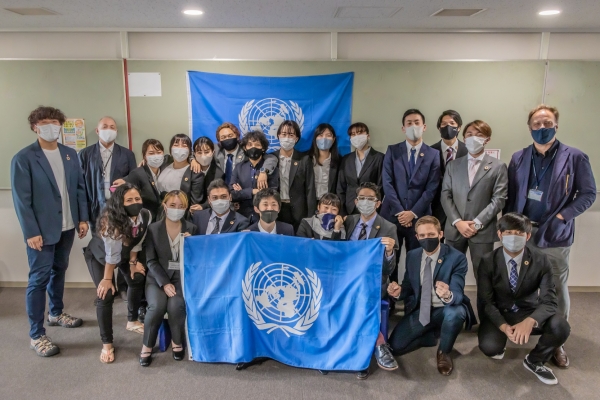 JUEMUN 2021
-
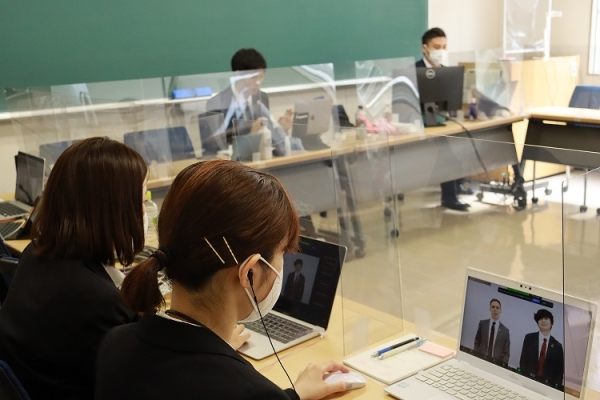 JUEMUN 2021
-
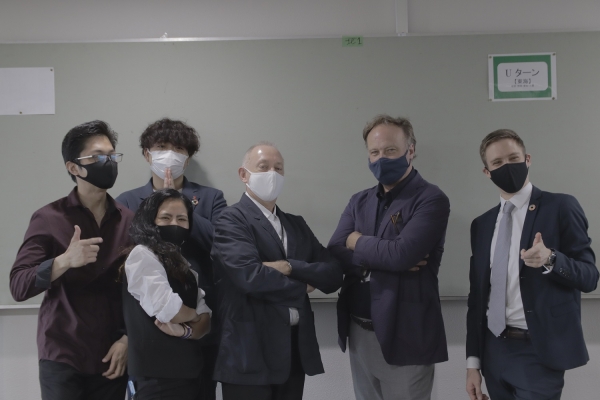 Profs. Gibson and McGregor with JUEMUN committee members


