


2026/11/09 11:30:00 Changemaker Series: Hideo Asano and the Courage to Imagine a World Without Nuclear Weapons 核兵器のない世界を思い描く
 イベント
 Junko Kondo
“Imagine a nuclear weapon were detonated right here, at Kyoto University of Foreign Studies.”
With this question, Mr. Hideo Asano, Coordinator of the Japan Campaign to Abolish Nuclear Weapons, opened his Changemaker Series talk for our third- and fourth-year students on 20 October. Suddenly, nuclear weapons were no longer a distant topic from history textbooks or news headlines. They were about our campus, our friends, and the people sitting next to us.
Mr. Asano is a vibrant young changemaker, and his passion filled the room from the very first minute. He spoke not only about the destructive power of a bomb on a single city, but also about “nuclear winter”: how a nuclear war could reach every corner of the earth. Smoke and soot would block the sunlight, crops would fail, and famine would spread far beyond the battlefield. Estimates show that even a relatively small-scale nuclear war between countries far from Japan could cause catastrophic famine, killing more than half of Japan’s population. He showed us the faces of the hibakusha, the atomic bomb survivors of Hiroshima and Nagasaki, as well as the faces of the “global hibakusha,” whose lands and bodies were harmed by nuclear testing around the world. We learned that behind every number, there are human lives.
The moment that stayed with many of us came during his second exercise. Mr. Asano asked us to imagine ourselves as the leader of a nuclear-armed country, and then showed a video simulating the minutes after a warning of an incoming nuclear attack. Alarms, conflicting reports, advisors waiting for an answer, and only minutes to make a decision. The simulation felt frighteningly real. Would we press the button? Could we even trust the information in front of us? We felt in our own bodies how challenging it is to make a “rational” decision under such pressure. And we were struck by a sobering truth: the fate of civilization can rest on one person, and a single error, false alarm, or misunderstanding could be enough to start a nuclear war.
Then came another shock. In 2025 alone, the nine nuclear-armed states spent a total of 118.8 billion USD on nuclear weapons. Mr. Asano invited students to calculate this amount in the currency of their home countries. He then asked us to imagine what that money could do instead: provide clean water, vaccines, food, and clean energy for millions of people, or plant countless trees. The question was no longer only “How dangerous are nuclear weapons?” but also “What kind of future are we giving up for them?”
Yet the talk was never only about fear. Mr. Asano shared how Japanese civil society is working for change: bringing together hibakusha and young people, holding dialogues with Diet members from across political parties, and raising the voices of Japanese citizens at the United Nations, where he himself has spoken. His message was clear. Change does not belong only to world leaders. It is built by ordinary people who refuse to give up.
On 21 October, Mr. Asano also joined our Global Engagement and Peace course. In both classes, students eagerly raised their hands.
One student asked, “Your lecture showed us a harsh reality, but it was also inspiring. What gives you hope despite the difficulties?”
Mr. Asano answered from the heart. There is strong demand from civil society, he said. And when he works with hibakusha, he sees people who, despite their painful life experiences, decided to stand up for peace so that no one on the earth will become “hibakusha” again. Seeing them, he said, inspires him and tells him how he should live.
Another student asked whether a nuclear-free world is truly possible. He answered, “Although many countries still rely on nuclear deterrence, tens of thousands of nuclear weapons have already been dismantled from more than 70,000 at the height to 12,000 today through dialogue and civil society pressure. So why shouldn’t we keep trying, and keep making the case for a nuclear-free world?”
Hope, we learned, is not the absence of difficulty. It is the choice to stand up anyway. As the hibakusha in Japan grow older, his presence means a great deal to Japanese society: he stays close to them with sincere respect and carries their message forward with empathy. His lecture inspired many students to get involved in the movement.
Thank you, Mr. Asano, for being with us and for showing us such a strong will to abolish nuclear weapons. s after class
-
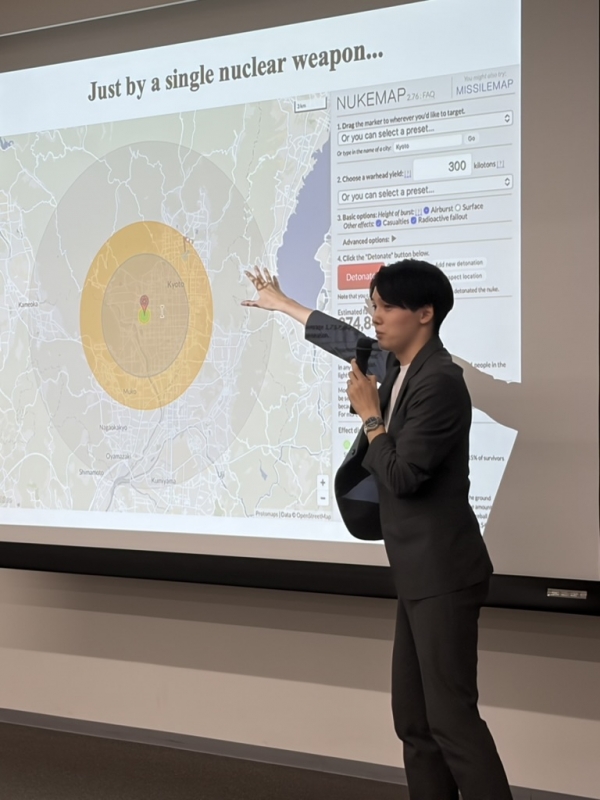 Mr. Asano presenting a simulation of a nuclear detonation at KUFS
-
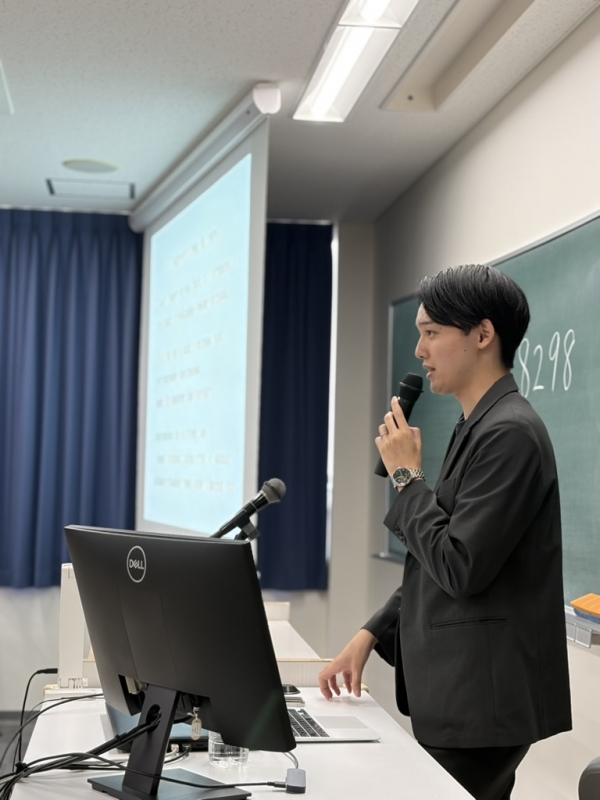 Mr. Asano speaking in the Global Engagement and Peace course
-
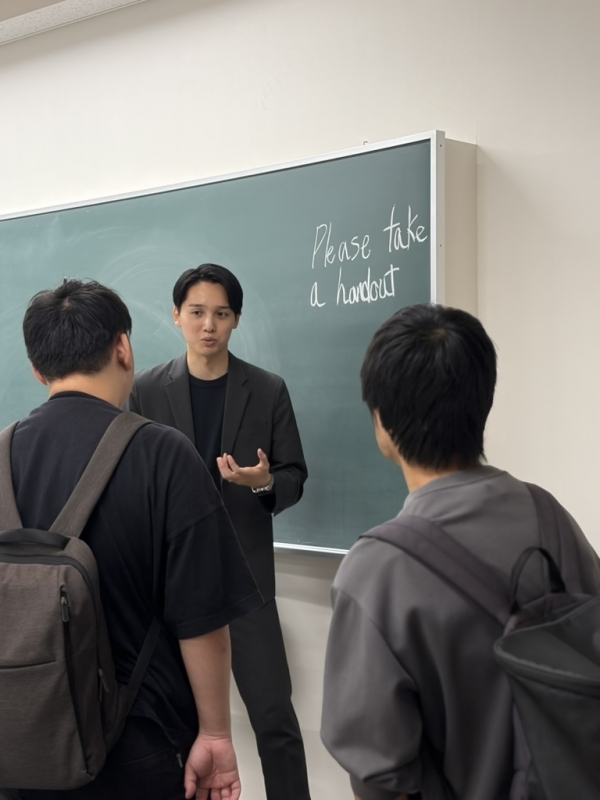 Students gathering to ask Mr. Asano questions after class


