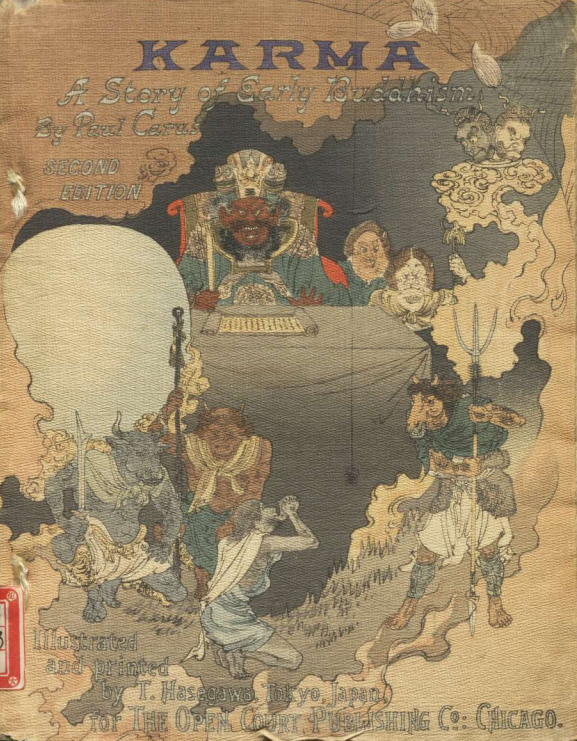
Karma : A Story of Early Buddhism
『カルマ』
(Karuma)
著者:ポール・ケイラス(Paul Carus)
本作は、仏教の根本思想である「業(カルマ)」を物語形式でわかりやすく紹介したものです。構成は「堤婆邏の米車」「婆羅奈市の取引」「山賊仲間」「蜘蛛の巣」「善根の応報」の5章から成り、特に「蜘蛛の巣」の章における罪人の救済をめぐる叙述は、芥川龍之介『蜘蛛の糸』の着想源として知られています。日本との縁も深く、1898年には鈴木大拙の翻訳による日本語版『因果の小車』が出版されました。 著者のケイラスは、19世紀末のアメリカで東洋思想の紹介に尽力したドイツ系の思想家です。1893年のシカゴ万博を契機に日本の「ちりめん本」への関心を深め、長谷川武次郎に協力を依頼しました。 本学所蔵本は1896(明治29)年に発行された第2版です。初版から第3版にかけて、版ごとに異なる絵柄の表紙が採用されていることが知られています。
Presented in the form of a series of stories, this work offers an accessible introduction to the Buddhist concept of karma, or the principle of cause and effect. It consists of five chapters: “Devala's Rice Cart,” “Business in Benares,” “Among the Robbers,” “The Spider Web,” and “The Bequest of a Good Karma.” The story of the redemption of a sinner in “The Spider Web” is particularly well known as an inspiration for Ryūnosuke Akutagawa’s The Spider’s Thread. The work also has a close connection with Japan. In 1898, a Japanese translation by Daisetsu Suzuki was published under the title Inga no Oguruma. Paul Carus, a German American philosopher and writer, devoted himself to introducing Eastern thought to American readers in the late nineteenth century. His interest in Japanese crepe-paper books deepened following his visit to the 1893 World’s Columbian Exposition in Chicago, prompting him to seek the publishing assistance of Hasegawa Takejirō. This copy is the second edition, published in 1896. The work is known to have appeared in three editions, each featuring a different cover design.